
Improving Quality Score is one of the most powerful and often misunderstood levers in Google Ads. When done correctly, it can dramatically improve ad position while lowering cost per click (CPC), effectively letting you buy more high-intent traffic for less.
In this post, I will break down how Quality Score works, why it directly impacts CPC, and how I applied a systematic approach to significantly improve performance for a real client.
Why Quality Score Matters
Quality Score (QS) plays a central role in how Google determines both ad rank and actual CPC. It is Google’s way of rewarding relevance and user experience.
Ad Rank and Position
Ad Rank determines whether your ad shows and where it appears on the search results page. It is calculated as:
Ad Rank = Bid × Quality Score
A higher Quality Score increases your Ad Rank without requiring higher bids, allowing you to win better positions more efficiently.
How Quality Score Lowers CPC
Your actual CPC is calculated based on the Ad Rank of the competitor below you, divided by your Quality Score:
Actual CPC = Ad Rank of competitor below ÷ Your Quality Score
This means that as Quality Score increases, the amount you need to pay to maintain a given position decreases.
Quality Score Scenarios Explained
To illustrate the impact, consider three simplified scenarios:
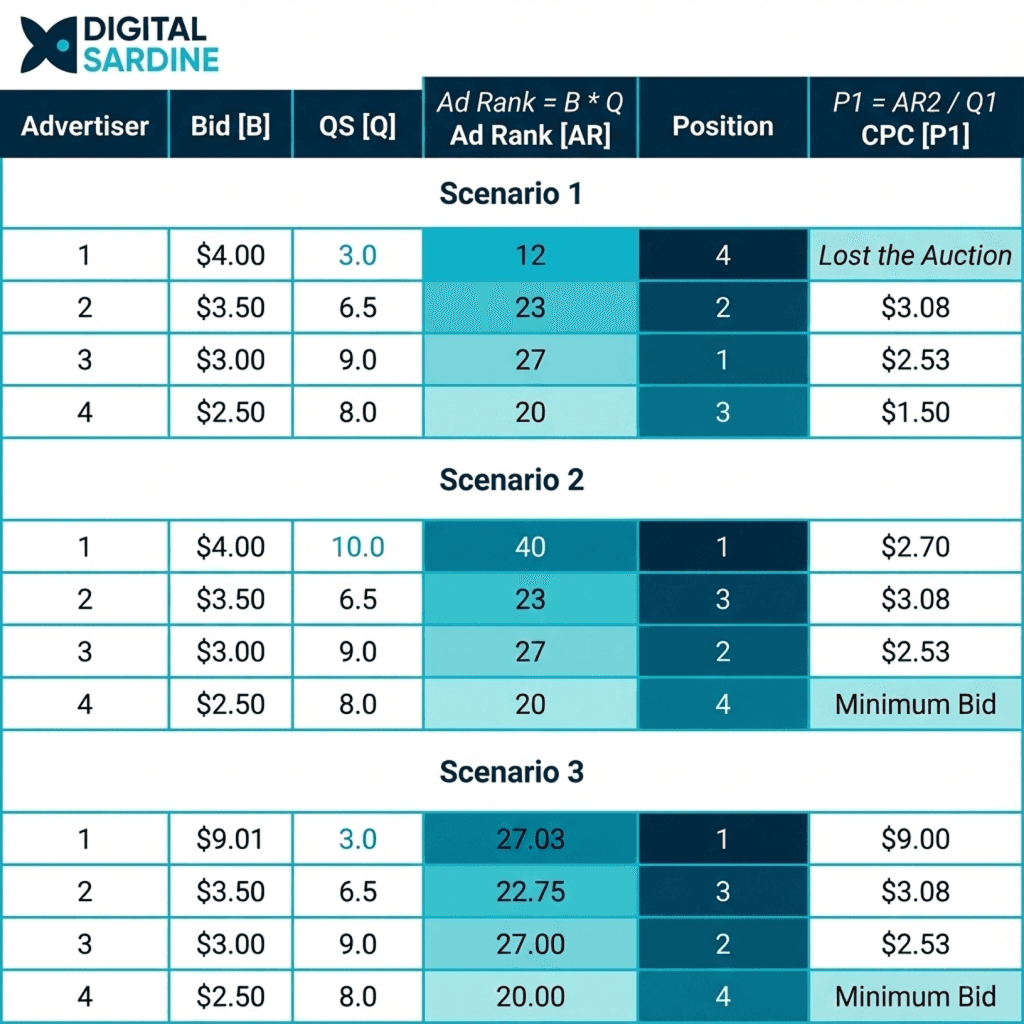
Scenario 1: Low Quality Score
Advertiser 1 has a Quality Score of 3 and bids $4. Even with a relatively high bid, they struggle to show consistently. If they do qualify, they appear in a lower position and pay close to their maximum bid.
Scenario 2: High Quality Score
Advertiser 1 improves their Quality Score from 3 to 10. With the same competitive landscape, they now secure the top position while paying a CPC of $2.70. They gain more visibility, more traffic, and pay less per click.
Scenario 3: Buying Position With Bids Alone
With a Quality Score of 3, Advertiser 1 would need to bid $9 to secure position one. That is an increase of $6.30 per click, or +233 percent, compared to having a Quality Score of 10.
The takeaway is simple: Quality Score is leverage.
Real Client Results
I worked with a client where we increased the average Quality Score from 6.5 to 9.5, weighted by impressions. The results were substantial:
CTR increased by 68 percent
Traffic increased by 61 percent
CPC decreased by 18 percent
Conversions increased by 3x
CPA decreased by 58 percent
All of this was achieved without increasing bids. The gains came from relevance, structure, and execution.
How I Improved Quality Score
1. Campaign and Account Structure
Rebuilt campaigns and ad groups around clear themes aligned with business goals
Kept ad groups tight with a manageable number of highly relevant keywords
Structured for automation, reporting clarity, and scalability
2. Keyword Optimization
Analyzed historical converting search terms and added them as exact and phrase match keywords
Negated irrelevant or low-quality queries with high impression volume and poor performance
Used keyword planning tools to uncover missing high-intent keywords with meaningful volume
3. Ad Copy Optimization
Fully utilized responsive search ads with all available headlines and descriptions
Incorporated the top search terms per ad group into headlines and descriptions
Highlighted unique value propositions across multiple headlines
Used dynamic keyword insertion selectively in one headline
Included core keywords in display URL paths
Pinned the strongest headline in position one for consistency and clarity
4. Landing Page Relevance
Matched landing pages closely to ad group themes
Ran A/B tests to identify which pages performed best for different keyword types
Ensured strong message match between keyword, ad, and landing page
5. Ad Extensions
Deployed relevant extensions including sitelinks, callouts, structured snippets, price, image, and app extensions
Customized extensions by ad group theme to reinforce relevance and improve CTR
6. Ongoing Quality Score Monitoring
Identified the top 30 keywords by conversion volume and search demand with Quality Scores below 9
Built a Looker Data Studio dashboard to monitor Quality Score trends and components
Optimized each of the 30 keywords individually, prioritizing those with high volume and low Quality Score
Discovered that “near me” keywords underperformed due to low expected CTR and fixed this by updating ad copy across the long tail
Final Thoughts
Quality Score is not a vanity metric. It is a direct driver of efficiency, scale, and profitability in Google Ads.
When you improve relevance across structure, keywords, ads, and landing pages, Google rewards you with better positions and lower CPCs. The result is more qualified traffic, stronger conversion performance, and significantly better returns on ad spend.
If you treat Quality Score as a system rather than a number, it becomes one of the most powerful growth levers in paid search.
Start optimizing deliberately, and let the algorithm work in your favor.






Featured contributor on the HubSpot

Sam Lauron Dec 14, 2023
When and How to Build International PPC Campaigns
“One-size-fits-all templates don’t work,” says Flavio Rodrigues, an SEM consultant who runs the consultancy, Digital Sardine. “There are differences in languages and dialects, currencies, user behaviors, and even payment methods,” he adds.