
There is no perfect international PPC setup, only tradeoffs between efficiency and coverage.
Language, location, and currency settings directly affect CTR, conversion rate, and long-term customer value, not just reach. Yet most travel brands still treat these decisions as mechanical defaults.
As a result, many brands unintentionally exclude 10–40% of incremental global demand by relying on country-first and official-language assumptions.
Language-led expansion into non-native markets is one of the cleanest ways to grow year over year without increasing CPCs or sacrificing ROAS.
If you are scaling a global travel program, this post outlines the framework used in large international portfolios to unlock incremental demand while maintaining efficiency.
Why global PPC settings are strategy, not defaults
Most global travel brands still approach PPC settings with a deceptively simple mindset:
Set the country
Choose the official language
Pick a currency
Launch
This approach looks clean in an account structure, but it leaves meaningful demand untapped.
International PPC behaves very differently from domestic paid search. Users research travel in multiple languages, often live outside their country of origin, and expect pricing and messaging that reflect where they live and who they are, not just where they are physically located.
The real objective of global travel PPC is not perfect settings. It is this:
Deliver the most relevant possible experience to each user, without creating more operational complexity than the business can sustain.
That goal is nuanced. And most brands underperform because they never address it directly.
Location and language are not “just settings”
In global travel programs, location targeting, language settings, currency, and landing page selection directly determine relevance. They influence:
Which users even see the ad
How trustworthy the message feels
Whether pricing creates confidence or friction
How efficiently demand converts
Treating these as mechanical defaults rather than strategic levers is one of the fastest ways to cap international growth.
Spain: what looks correct is often incomplete
Baseline setup (common but insufficient)
Location targeting: Spain
Language targeting: Spanish
Landing page: Spanish
Currency: EUR
This is a reasonable starting point. It is not a sufficient final answer.
Spain is not monolingual
Spain’s linguistic reality is far more complex than many campaign structures reflect:
Approximately 81–82% of residents report Spanish (Castilian) as their first language
Around 10% speak Catalan (including Valencian), which is co-official in multiple regions
Galician and Basque are also co-official regional languages
Millions of residents primarily use English, Arabic, Romanian, French, Portuguese, and other languages
From a Google Ads perspective, this matters because Catalan is an official language option in the platform. If you are not targeting it, you are explicitly excluding users whose browser language is set to Catalan.
Political borders also do not define user behavior. Andorra, while not part of Spain, behaves similarly in terms of language, currency, and travel intent, and often represents incremental, efficient volume when included.
Why there is no “correct” setup
For global programs, country, language, currency, and landing page choices interact in non-obvious ways:
Google Ads language targeting is based on browser and interface settings, not native language or intent
Users frequently search in a language they understand, not necessarily their native one
Currency preference is often tied to residence and banking, not physical location
As a result, every setup has limitations. The right question is not “what is correct?”
It is:
Which limitations are we willing to accept, given our growth and efficiency goals?
Two viable approaches for Spanish users in Spain
Option 1: Conservative, efficiency-oriented
Ads: Spanish
Language targeting: Spanish + Catalan
Currency: EUR
Location: Spain + Andorra
This approach prioritizes strict relevance and ROAS. It aligns well with businesses that value efficiency over absolute reach.
The tradeoff is coverage. Spanish users searching in English or other languages are intentionally excluded.
Recommended test:
Duplicate the campaign:
Original: Spanish (or Spanish + Catalan)
Test: All languages except Spanish (or except Spanish + Catalan)
Compare incremental volume, efficiency, and search terms. This reveals whether “Spanish market” demand is actually occurring in non-Spanish language contexts.
Option 2: Broader coverage, scale-oriented
Ads: Spanish
Language targeting: All languages except those handled by other dedicated accounts (e.g. FR, DE, IT, PT)
Currency: EUR
Location: Spain + Andorra
This approach can drive growth, but introduces:
Market overlap and cannibalization
More complex reporting and attribution
Higher operational overhead
It typically suits brands prioritizing topline growth over strict efficiency.

Language targeting is imperfect by design
This is a critical limitation many guides gloss over.
Google Ads does not know a user’s native language. It infers language from browser and interface signals.
That means:
Spanish users may search in English
English speakers may search in Spanish
Bilingual users switch languages dynamically
This is why no language strategy is ever perfect, regardless of how carefully designed.
Language preference materially affects conversion behavior
This complexity matters because language choice impacts performance, not just reach.
A large multi-country consumer study by CSA Research (8,709 consumers across 29 countries) found:
76% of consumers prefer to buy products with information in their native language
40% say they will never buy from a website that is not in their own language, even if they speak English fluently
Other studies consistently show higher trust, engagement, and conversion rates when communication occurs in a user’s primary language rather than a secondary one.
As Nelson Mandela famously said:
“If you talk to a man in a language he understands, that goes to his head.
If you talk to him in his language, that goes to his heart.”
For travel brands, this directly translates into differences in CTR, conversion rate, and long-term customer value.
Currency is a second axis of relevance
Even when language is correct, currency mismatches create friction.
Users tend to expect pricing in:
The currency of the country where they live and work
The currency tied to their bank account
The currency they transact in daily
For example, a Spanish user living in the UK may reasonably expect:
GBP pricing
English or Spanish messaging depending on browser language
A landing experience aligned with UK residency
Defaulting all Spanish traffic to EUR can quietly suppress conversion rates.
Spanish speakers outside Spain: a major blind spot
A common assumption in travel PPC is:
“We have a Spanish website, so we only need to target Spain.”
This ignores Spanish-speaking users living abroad, including in the UK, Germany, France, Ireland, and other European markets.
These users often:
Travel more frequently
Have higher disposable income
Search in Spanish even when residing in non-Spanish-speaking countries
Campaigns explicitly designed to capture this audience often show lower competition, strong CTRs, and high conversion rates.
A simple data point that explains the opportunity
Using Google Ads keyword data for “vuelos baratos” (cheap flights):
Spain
Avg. monthly searches: ~550,000
Competition index: 78
Germany, UK, Ireland, France, Italy, Portugal (combined)
Avg. monthly searches: ~49,500
Competition index: ~73
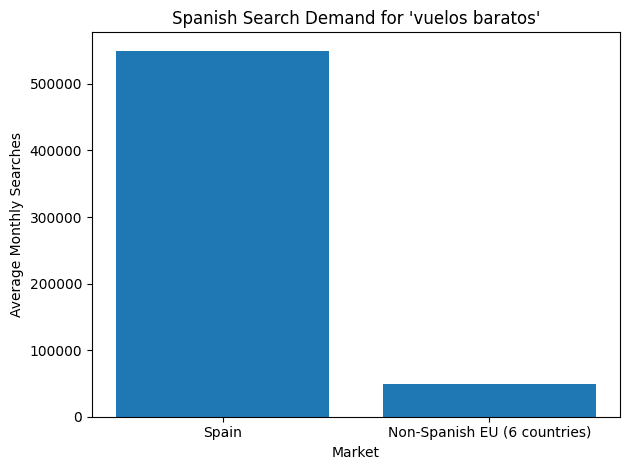
This means Spanish-language demand in just six non-Spanish-speaking European countries represents almost 10% of Spain’s volume for this query, with lower competition.
This is a single query and a limited set of markets. It is not an exhaustive market study. It is a structural signal.
Applied across:
Thousands of queries
Multiple languages
Multiple regions
What looks small at the keyword level becomes material growth at the portfolio level, without increasing CPCs or sacrificing efficiency.
The strategic takeaway
There is no universally correct combination of:
Country
Language
Currency
Landing page
Every choice introduces tradeoffs.
High-performing global travel PPC programs succeed not because they found perfect settings, but because they intentionally choose which imperfections to accept.
Most brands do not lose performance because they chose the wrong configuration. They lose performance because they never realize how much demand they are excluding.





Featured contributor on the HubSpot

Sam Lauron Dec 14, 2023
When and How to Build International PPC Campaigns
“One-size-fits-all templates don’t work,” says Flavio Rodrigues, an SEM consultant who runs the consultancy, Digital Sardine. “There are differences in languages and dialects, currencies, user behaviors, and even payment methods,” he adds.