
Search advertising costs are rising. Not anecdotally. Not selectively. Structurally.
Multiple independent data sources confirm that cost-per-click inflation is happening across Google Ads.
Alphabet’s 2025 Form 10-K shows paid clicks up 6% year over year while cost-per-click increased 7%. Skai’s Q3 2025 Trends Report shows paid search spend up 9%, CPC up 9%, and clicks flat. WordStream’s 2025 Google Ads Benchmarks report that 87% of industries experienced CPC increases. Long-term analysis published by Search Engine Land suggests travel CPC growth has compounded at roughly 16–17% annually for high-spend terms.
Different datasets. Different methodologies. Same directional signal.
Search clicks are getting more expensive.
That makes intuitive sense. Broader inflationary pressures exist. Competition is intensifying. Budgets are consolidating around high-intent inventory.
But here is what is especially interesting:
According to the same Skai report, retail media CPC increased only +2% year over year, while paid social CPM declined –5% year over year.
Search is where inflation is concentrating.
And yet, that is not the whole story.
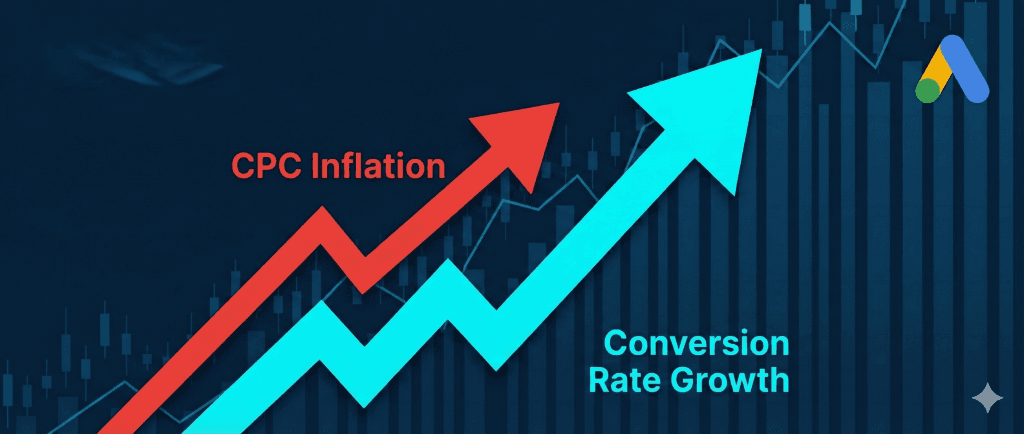
Because higher CPC does not automatically mean worse performance.
In many cases, under Smart Bidding, higher CPC is a feature — not a bug.
Why Higher CPC Often Correlates With Higher Conversion Rate
Under Google’s Smart Bidding (tCPA and tROAS), bidding is probabilistic.
For every auction, the system estimates the probability of conversion for that specific user and context. In simplified terms:
Bid ≈ Target CPA × Probability of Conversion
If the algorithm determines a high likelihood of conversion, it bids aggressively. If the probability is low, it bids conservatively or not at all.
This creates a natural internal correlation:
In a well-optimized Smart Bidding campaign, the highest CPC clicks should also have the highest conversion rates.
Industry benchmarks support this pattern. Data shared across platforms like WordStream and Optmyzr consistently shows:
Broad, research-oriented queries tend to have lower CPC and lower conversion rates.
High-intent purchase queries command higher CPC but convert at materially higher rates.
Extremely competitive categories may show very high CPC driven by competitor demand, not just user intent.
The key distinction is intent-driven CPC versus competition-driven CPC.
When CPC rises because the algorithm identified strong intent signals, efficiency often improves.
When CPC rises because of ego bidding or forced top-of-page positioning, efficiency suffers.
Real-World Tests: Higher CPC, Lower CPA
Across anonymized high-intent accounts, we tested manual bidding against Smart Bidding.
Short-Term Controlled Transition
After accumulating sufficient conversion data, a tightly grouped set of high-intent exact-match keywords was moved from manual CPC to automated bidding (Maximize Conversion Value with a target constraint).
Two weeks after the switch compared to the two weeks prior:
Impressions: –43%
CTR: –53%
Spend: –61%
CPC: +46%
Conversions: +25%
Conversion rate: +369%
CPA: –69%
Conversion value: +36%
Nothing else changed. Same keywords. Same landing pages. Same offer.
The algorithm became highly selective.
It eliminated low-probability traffic and paid a premium only when expected conversion value justified it.
Fewer clicks. Higher intent. Lower cost per acquisition.
CPC increased nearly 50%, yet efficiency improved dramatically.
Year-Over-Year Transitions
In another anonymized account after transitioning to automated bidding:
CPC increased 40–50%
Conversion rate improved more than 125%
Total conversions increased roughly 70%
Cost per conversion decreased more than 30%
In a separate account over a completed month:
CPC: +42%
Conversion rate: +127%
Conversions: +164%
Cost per conversion: –37%
Lower CPC did not mean better performance.
Higher CPC with better probabilistic targeting did.
The Selective Constraint Effect
When you give Smart Bidding a strict CPA or ROAS target, the system becomes hyper-selective.
It bids only in auctions where expected value exceeds your constraint.
That often results in:
Lower impressions
Lower CTR
Higher average CPC
Significantly higher conversion rate
Average CPC rises because low-cost, low-quality clicks are removed from the mix.
Importantly, this can happen even with the same keywords and search terms. Keywords are only one signal. Google’s algorithm uses thousands of additional signals, including in-browser behavior, device, time, historical engagement patterns, in-market audiences, and contextual signals. Two identical keywords can trigger auctions with vastly different predicted conversion probabilities.
This is frequently misinterpreted as “inflation hurting performance,” when in reality it reflects stronger qualification.
The Bigger Picture
When you combine:
Alphabet’s financial disclosures showing rising CPC
Skai’s Q3 data showing +9% paid search CPC while other channels remain stable
WordStream benchmarks confirming broad-based industry increases
Search Engine Land’s analysis highlighting elevated CPC growth in competitive verticals
Real-world Smart Bidding transitions showing 40–50% higher CPC with materially lower CPA
The conclusion becomes clear.
Search is getting more expensive.
But it is also getting more selective.
The brands that win in 2026 will not be the ones obsessing over lowering CPC.
They will be the ones increasing conversion rate faster than CPC rises.
Because in modern search, the real lever is not cost per click.
It is cost per qualified intent moment.
And that is where competitive advantage now lives.




Featured contributor on the HubSpot
Sam Lauron Dec 14, 2023
When and How to Build International PPC Campaigns
“One-size-fits-all templates don’t work,” says Flavio Rodrigues, an SEM consultant who runs the consultancy, Digital Sardine. “There are differences in languages and dialects, currencies, user behaviors, and even payment methods,” he adds.