
Every year, the travel industry publishes trend reports. Most of them say the same thing in slightly different words: travelers want experiences, AI is growing, sustainability matters.
That's not useful. What's useful is understanding how specific behavioral shifts are changing the way people search, plan, and book — and what that means for how you allocate budget, structure campaigns, and position your brand.
This piece distills data from over a dozen 2026 industry reports, including UN Tourism, Skift Research, Expedia Group, American Express, Amadeus, Hilton, Skyscanner, Think with Google, and the U.S. Travel Association — into the seven shifts that actually matter for travel brands running paid media.
Some of these are accelerating trends. Some are new. All of them carry real implications for how you compete in search and social.
The Macro Context: Strong Demand, New Complexity
Before we get into specifics, the big picture matters.
International tourist arrivals grew 4% in 2025, reaching an estimated 1.52 billion travelers worldwide — a new post-pandemic record, according to the UN Tourism World Tourism Barometer (January 2026). International tourism receipts hit approximately $1.9 trillion, with total export revenues from tourism reaching roughly $2.2 trillion. Europe led with 793 million arrivals, 6% above 2019 levels. Asia and the Pacific grew 6% but still sits 9% below pre-pandemic figures.
For 2026, UN Tourism projects another 3–4% growth. Skift Research calls it a market defined by resilience rather than acceleration, projecting approximately 5% global industry growth.
Demand is strong. But how that demand behaves has fundamentally shifted. That's where most brands are falling behind.
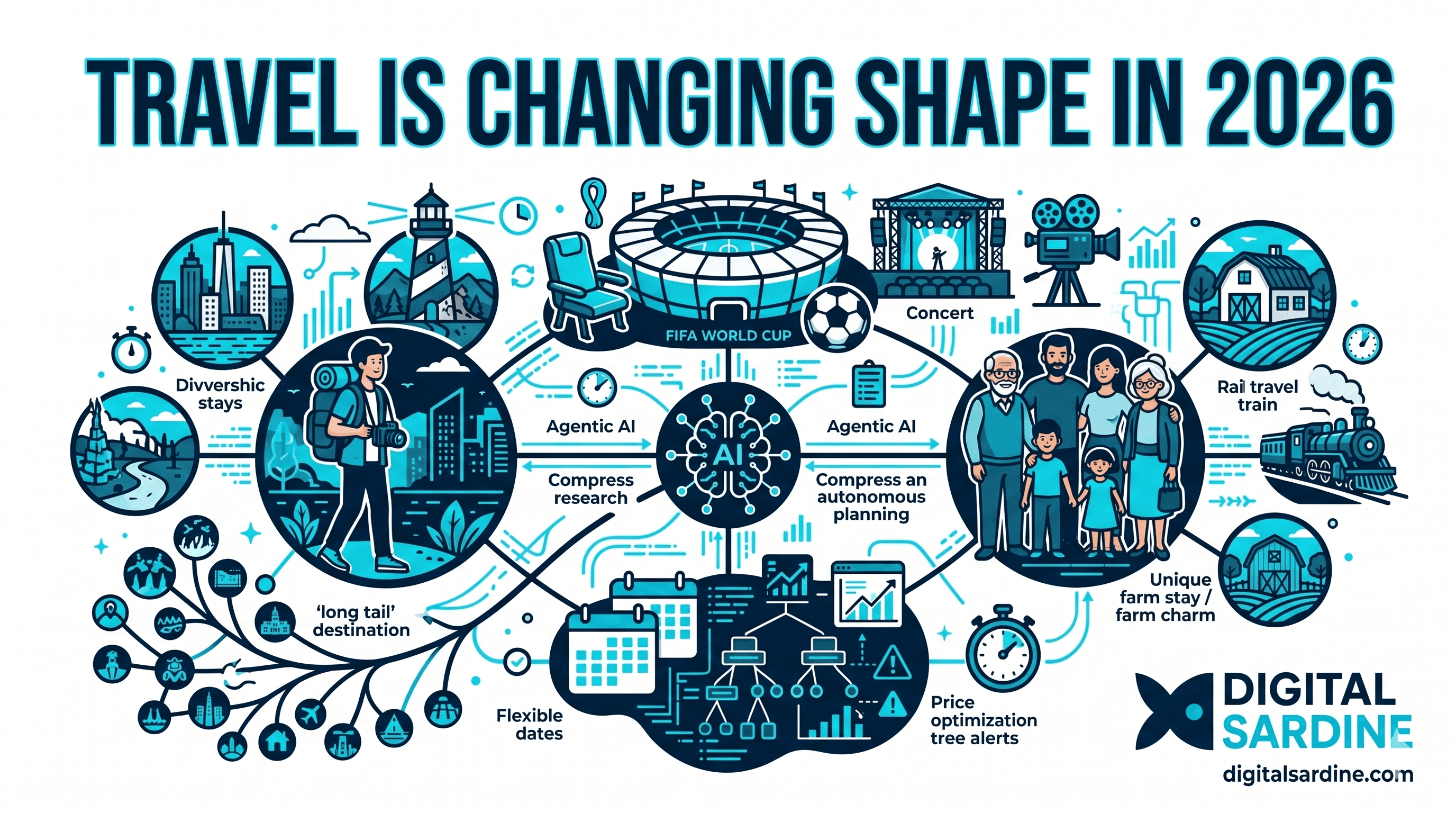
1. Travel Decisions Now Start With "Why," Not "Where"
Hilton's 2026 Trends Report, based on an survey of over 14,000 travelers across 10 countries, identifies what they call the "Whycation", travel that begins with a motivation, not a destination.
This isn't marketing language. The data is consistent across sources.
American Express Travel's 2026 Global Trends Report found that two-thirds of respondents plan to take a trip specifically to celebrate a milestone for someone else. Meanwhile, 79% of Millennials and Gen Z surveyed say they're likely to seek out local workshops or classes specific to the destination they visit. And 74% of Millennials and Gen Z call travel a "non-negotiable" expense.
Skyscanner's 2026 Trends Report, surveying 22,000 global travelers, confirms the same pattern: travelers are increasingly beginning their search with individual passions and hobbies rather than selecting a destination first.
Amadeus calls this "Travel Mixology", travelers flitting between platforms, combining AI recommendations, social content, friend advice, and platform chatbots to assemble their ideal trip. They also note that travelers using generative AI for trip planning jumped from 11% to 18% in a single year, a 64% increase. At the same time, one in four travelers reported receiving incorrect or outdated information during AI-assisted planning, and fewer than half said they fully trust AI.
What this means for paid search:
The keyword landscape is shifting upstream. Queries like "best anniversary trip" or "wellness retreat for burnout" don't fit neatly into destination-based campaign structures. If your campaigns are organized exclusively by city or country, you're invisible to people who haven't picked a destination yet.
This is an opportunity to build campaigns around intent clusters, not just geography. Research and planning queries are where influence happens. By the time someone searches "hotels in Barcelona," the decision has largely been made. The brands that shaped that decision captured value upstream.
2. Demand Is Fragmenting Across More Destinations
I've written about this in detail, Travel Demand Is Growing, but It's Expanding to More Places Than Ever — and the data has only strengthened since.
Google's latest research with Alvarez & Marsal (the Think with Google "Travel 2050" report) projects that the market share of today's top five destinations will drop from 26% to 18% by 2050, as growth increasingly spreads to a broader set of countries. Google Hotel Ads data also shows that consumer interest in secondary cities like Sapporo surged 45% in 2025, more than double the growth rate for Tokyo and Osaka. Similar patterns appeared for Chiang Mai relative to Bangkok and Strasbourg relative to Paris.
CNBC's analysis of 25 year-end travel reports found that accommodation searches in Asia's secondary destinations are growing 15% faster than traditional hubs, citing Agoda data. Governments are responding — Indonesia launched its "Tourism 5.0" strategy to develop five secondary destinations beyond Bali, and Japan is leaning into regional campaigns to shift visitors away from major city centers.
This fragmentation isn't a passing curiosity. It's structural.
What this means for paid search:
If your campaign architecture is built around 10–20 core destinations, you're competing harder for smaller marginal gains. The opportunity is in long-tail destination coverage — capturing demand that's growing faster, converting cheaper, and facing less auction pressure. I covered the CPC and competition data behind this in the demand fragmentation piece.
3. Solo Travel Is Now a Mainstream Segment
Solo travel is no longer niche. It's one of the fastest-growing segments in the industry.
The global solo travel market was valued at approximately $482 billion in 2024 and is projected to reach roughly $1 trillion by 2030, according to Grand View Research. The U.S. solo travel market alone is expected to grow at a 12.4% CAGR through 2030. Booking.com data shows that pre-pandemic, 14% of travelers went solo, by mid-2021 that had nearly doubled to 23%. More recent data from Globus suggests 27% of travelers plan to go solo on their next trip, double the rate from just a few years earlier.
The demographics matter for targeting: women account for roughly 65–85% of solo travelers depending on the source. Solo travelers aged 25–40 represent the largest cohort at about 44% of the market. And critically, solo travelers spend about 20% more per day than group travelers on experiences.
Solo travel demand also skews toward off-season and secondary destinations, which compounds the fragmentation trend discussed above.
What this means for paid search:
If your messaging and landing pages default to couples, families, and groups, you're creating a relevance mismatch for a growing and high-spending audience. Solo travelers also tend to be more research-heavy, they rely more on reviews, safety information, and logistical detail before booking. That means longer planning cycles and more upper-funnel touchpoints. Campaigns targeting solo travel queries still face far less competition than generic destination terms, making this a clear efficiency play.
4. Pop Culture and Sports Events Are Creating Demand Spikes
Expedia Group's Unpack '26 report highlights "Fan Voyage" as a defining trend — travel driven by sporting events, entertainment, and cultural moments. Amadeus calls it "Pop Culting" and provides striking data: Netflix's K-Pop Demon Hunters, with over 300 million views, drove a 19% increase in air bookings to Seoul for 2026, with bookings from Japan up 33% and from the U.S. up 30%.
And then there's the FIFA World Cup 2026 — the single largest demand event of the year.
U.S. Travel Association research, based on over 9,500 respondents across 10 markets, found that international World Cup visitors expect to spend over $5,000 per person — 1.7 times more than typical international travelers to the U.S. One in three plan to stay longer than two weeks. And more than 80% are open to visiting destinations beyond the largest gateway cities.
With 104 matches across 16 host cities in the U.S., Canada, and Mexico, the World Cup will generate concentrated demand surges in specific DMAs on specific dates. This isn't hypothetical future demand. It's happening within weeks.
What this means for paid search:
Event-driven demand creates temporary but massive spikes in high-intent, high-value queries. If you're in the travel space and haven't already built campaigns for World Cup–adjacent demand — lodging, flights, experiences in host cities — you're leaving money on the table. More broadly, pop culture and entertainment IP are becoming legitimate targeting signals. Brands that build campaign infrastructure around cultural moments will capture incremental demand that pure destination campaigns miss entirely.
5. AI Is Reshaping Discovery — But Not Where Most People Think
Generative AI adoption for travel planning grew 64% year-over-year according to Amadeus, from 11% to 18% of travelers. IPX1031's 2026 survey found that 3 in 10 Americans will use AI to plan trips this year — with the top uses being discovering activities and restaurants (65%), finding destinations (56%), and building itineraries (55%). Google's Travel 2050 report with Alvarez & Marsal describes the next step: agentic AI that doesn't just answer questions but autonomously manages trips — booking, rebooking during disruptions, adjusting preferences across sessions. Google has announced travelers will soon complete flight and hotel bookings directly through AI Mode in Search.
The shift is also changing what travelers discover. Think with Google's Hotel Ads data shows that secondary cities like Sapporo grew 45% in interest versus 2025 — more than double the growth rate for Tokyo — precisely because AI-powered tools surface alternatives that traditional search behavior wouldn't have uncovered. AI Max for Search campaigns are producing measurable results, with one OTA reporting 17% more bookings after deployment.
But the conversation around all of this is too binary. Either "AI is killing search" or "nothing has changed." Neither is accurate. What's actually happening is specific: AI Overviews are absorbing organic click-through rates on exploratory queries — "where should I go in autumn," "best areas to stay in Lisbon." Demand hasn't disappeared. It's being redistributed. For travel brands that relied on SEO for discovery, declining organic sessions are already visible without a corresponding drop in search demand.
What this means for paid search:
Paid search is structurally advantaged in this environment, at least for now. Ads still sit above or alongside AI Overviews on commercial queries. When someone searches for specific flights, hotels, or activities, that intent is still captured through paid channels. Well-structured paid search programs are absorbing part of the organic leakage. Poorly structured ones are not.
The key distinction: exploratory queries are shifting to AI, and AI handles them well — but those queries weren't converting efficiently through paid search anyway. High-intent, transactional queries haven't meaningfully changed. Paid search is a bottom-of-funnel channel. The problem isn't the channel. It's expecting it to solve top-of-funnel discovery.
AI visibility and paid search operate on completely different timelines. AI is a medium-term shift worth investing in thoughtfully. Paid search inefficiency is a present-tense problem already costing you bookings. In audits, it's common to find 20–40% efficiency upside just from fixing structure and segmentation — demand that already exists and isn't being captured. Fix the system that's already driving revenue before you optimize for the next one.
6. Experience-First Travel Is Changing What "Destination" Means
This isn't just a vague industry platitude anymore. The data is concrete.
According to Accor's 2026 research, 25% of travelers now begin their search with "a vibe or a feeling" rather than a specific destination. American Express found that 83% of Millennial and Gen Z travelers prioritize unique, authentic experiences over popular tourist attractions. And 87% say they leave room in their itinerary for unexpected local discoveries.
Expedia Group's Unpack '26 highlights "Readaways" (literary-themed escapes), "Farm Charm" (rural stays), and "Salvaged Stays" (historic spaces converted into immersive accommodations) as concrete expressions of this shift. Hilton's data shows travelers are choosing trips around specific motivations — reconnecting, recharging, discovery — rather than pinning a destination first.
Meanwhile, Explore Worldwide reports that rail bookings for 2026 are up 41% year-over-year, as travelers combine slow travel with experiential multi-stop itineraries.
What this means for paid search:
Campaign structure still defaults to destination-first hierarchies. But travelers increasingly search by experience type: "best food tours in Europe," "wellness retreats near the coast," "historic hotels to visit." These are category queries, not destination queries. If your campaign architecture can't serve both, you're structurally blind to a growing portion of demand. This also reinforces the need for richer landing page content — guides, itineraries, editorial content — not just booking pages.
7. Travelers Are Optimizing Harder Than Ever
Price sensitivity hasn't gone away, it's become more sophisticated.
Google's own search data shows queries for "best time to book flights" hit all-time highs. Searches for "travel hacks" are up over 150% year-over-year. Skyscanner reports billions of price-driven searches, with travelers increasingly using flexible date tools and price tracking alerts.
The U.S. Travel Association's Insights Dashboard shows February 2026 travel spending rose 3.4% year-over-year to $102 billion, with hotel RevPAR turning positive across all location types. But forward-looking indicators are cautious: tariff-related supply shocks, oil prices, and financial market volatility may pressure consumer spending. U.S. Department of Commerce international air travel data, as reflected in the U.S. Travel Dashboard, shows overseas arrivals turned positive in February 2026 after nine consecutive monthly declines, though year-to-date arrivals remain 1.9% below the prior year.
CNBC's analysis found that 45% of Virtuoso travel advisors report clients adjusting plans due to climate change, with 76% noting increased interest in shoulder-season or off-peak travel.
What this means for paid search:
Planning cycles are getting longer and more complex. Travelers enter and exit the funnel multiple times, comparing across more options and waiting for optimal pricing. If your attribution model is last-click and your conversion window is seven days, you're systematically undervaluing upper-funnel touchpoints and misattributing conversions. Adjust attribution windows, build for multi-touch journeys, and expand into timing-related queries ("best month to visit X," "cheapest time to fly to Y"). These aren't low-intent queries. They're high-consideration queries with clear commercial value.
What This All Points To
These seven trends are not independent. They're all reinforcing the same structural shift:
Travel demand is growing, but it's becoming more distributed, more intentional, and more complex.
Most brand campaign architectures were built for a simpler era — concentrated demand, destination-first decision-making, short planning cycles, and clean attribution.
That model is breaking.
The brands that will win in 2026 and beyond are the ones that expand beyond bottom-funnel capture into research and discovery; diversify destination strategy to cover the long tail, not just the head; adapt messaging for solo travelers, experience-seekers, and event-driven audiences; build content that supports AI surfacing and recommendation engines; and adjust attribution and bidding for longer, more complex journeys.
The opportunity isn't just in spending more. It's in spending differently.
Sources
UN Tourism – World Tourism Barometer & Factsheet (January 2026)
Skift Research – 2026 Outlook & Data Pulse
Amadeus & Globetrender – Travel Trends 2026 Report
Expedia Group – Unpack '26 (24,000 respondents, 18 countries)
American Express Travel – 2026 Global Travel Trends Report (Morning Consult, 8,000+ respondents)
Hilton – 2026 Trends Report (Ipsos, 14,009 travelers, 10 countries)
Skyscanner – 2026 Travel Trends (OnePoll, 22,000 travelers)
Think with Google / Alvarez & Marsal – Travel 2050: Demand & AI (January 2026)
U.S. Travel Association – Travel Insights Dashboard & 2026 FIFA World Cup Research (9,500+ respondents)
U.S. Department of Commerce – International Air Travel Statistics (via U.S. Travel Insights Dashboard)
World Travel & Tourism Council – Economic Impact Research (referenced via Expedia Group Smart Travel Health Check & U.S. Travel Association)
Grand View Research – Solo Travel Market Report (2026–2033)
Booking.com, Agoda, CNBC, Accor, Explore Worldwide, IPX1031 – Travel industry trend analyses and surveys



Featured contributor on the HubSpot
Sam Lauron Dec 14, 2023
When and How to Build International PPC Campaigns
“One-size-fits-all templates don’t work,” says Flavio Rodrigues, an SEM consultant who runs the consultancy, Digital Sardine. “There are differences in languages and dialects, currencies, user behaviors, and even payment methods,” he adds.