
UPDATE (June 2026): What I missed
After publishing this piece, I noticed something that sharpens rather than softens the original argument. Booking.com and Hilton ARE running ads on ChatGPT. They're just running them on the wrong queries.
While researching long-term apartment rental queries for an unrelated project, ChatGPT served me these two ads.
Booking.com on a long-term apartment rental query.
The query: "Best apartment buildings for rent in downtown Seattle." ChatGPT recommended actual long-term apartment buildings (10 Clay, The Olivian, Tower 12, The Residences at Rainier Square). Below the response, Booking.com served a sponsored ad with the headline "Seattle - Search a wide range of apartments in Seattle."
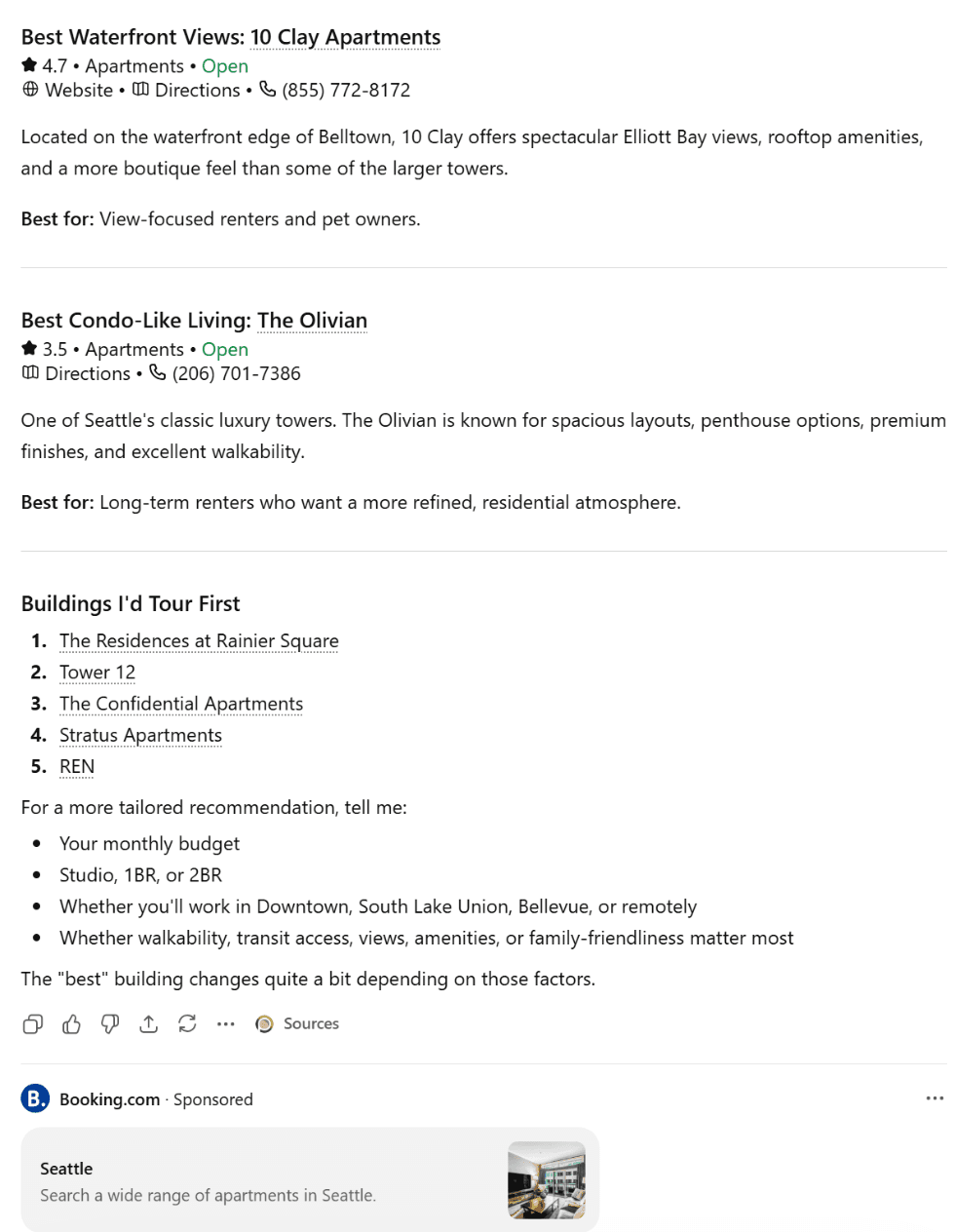
Query: "Best apartment buildings for rent in downtown Seattle." Booking.com served an ad immediately below the AI response.
Booking.com sells short-term stays. The user is searching for a 12-month lease, not a 3-night vacation rental.
Hilton on a neighborhood-for-renters query.
The query: "Best neighborhoods to rent an apartment in Austin with good public transportation." ChatGPT produced a ranked comparison of Austin neighborhoods (Hyde Park, Mueller, Downtown, Highland, North Loop) with transit and walkability scores. Below the response, Hilton served a sponsored ad with the headline "Best Places in Austin - Explore top neighborhoods travelers love most."
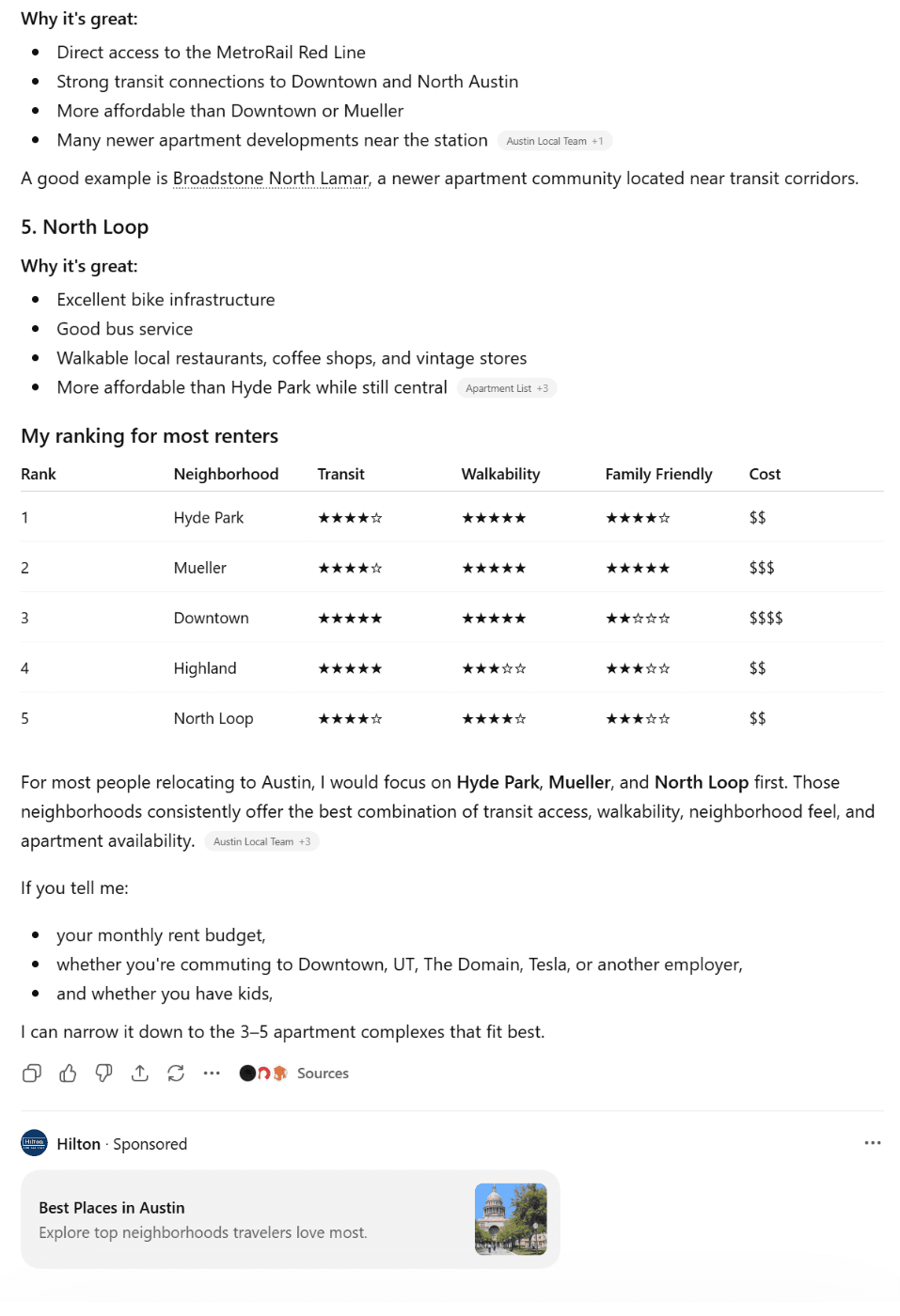
Query: "Best neighborhoods to rent an apartment in Austin with good public transportation." Hilton served an ad immediately below the AI response.
Hilton rents hotel rooms. The user is researching where to sign a long-term residential lease.
The diagnosis. Both ads are real and active. They're not platform bugs. They are paid campaigns running with loose context hints, broad targeting, and a brand-awareness framing of the channel. The platform is doing exactly what it's designed to do, matching context hints to relevant-seeming queries. The advertisers configured the targeting too broadly, so the matching pulls in queries far outside their actual product.
This is the classic upper-funnel mistake applied to a direct-response surface. Brand teams treat new channels as awareness opportunities. They buy "reach" and "consideration." On ChatGPT Ads, that produces exactly what it produces on Google paid search with the same settings: impressions and clicks on queries the advertiser doesn't want to serve.
What this means for the original argument. The claim earlier in this post that "Expedia is alone in lodging" was accurate for the lodging queries tested at the time of writing. The updated picture is more interesting: more major travel brands are entering the platform, but most are mismanaging the channel. Booking and Hilton are paying to surface on long-term rental queries that have nothing to do with their actual product. Expedia is paying to surface on specific destination-plus-property-type queries that match their inventory exactly.
Same channel. Opposite playbooks. The "no new playbook" thesis holds harder than ever. ChatGPT Ads is not a new awareness channel. It behaves like Google paid search. Intent matching is the lever. Loose context hints and broad targeting on a direct-response surface produces wasted spend, not brand lift.
That widens rather than narrows the window for travel brands that match query intent tightly to product. The first-mover advantage is now not just about being early. It's about being early AND configured correctly. The big brands are already here. Most of them are doing it wrong.
ORIGINAL ANALYSIS (May 2026): What I found inside the platform
I've spent the last three weeks living inside ChatGPT Ads, surfacing live ads as a user and building campaigns as an advertiser in Ads Manager Beta. I went in to answer one question for the brands I work with: is this a real performance channel yet, or just hype?
Here's what I found, how the platform actually works, and the one thing the most sophisticated travel advertiser on it is already doing that most brands will overlook. I'm running ChatGPT Ads now for travel and B2C clients, and this is the breakdown I wish I'd had before I started.
What a ChatGPT travel ad actually looks like
Ads appear below the AI's answer, not inside it. They're labeled "Sponsored." The format is a card with a headline (40 characters), a description (around 150 characters), and clickable link. There's also a shopping-card format for product queries that pulls price and review data, but travel ads use the standard sponsored card.
Here's what I found across dozens of travel queries.
When the query is specific (destination + property type), the ad and LP are fully tailored
Query: "best cabins in Lake Tahoe"
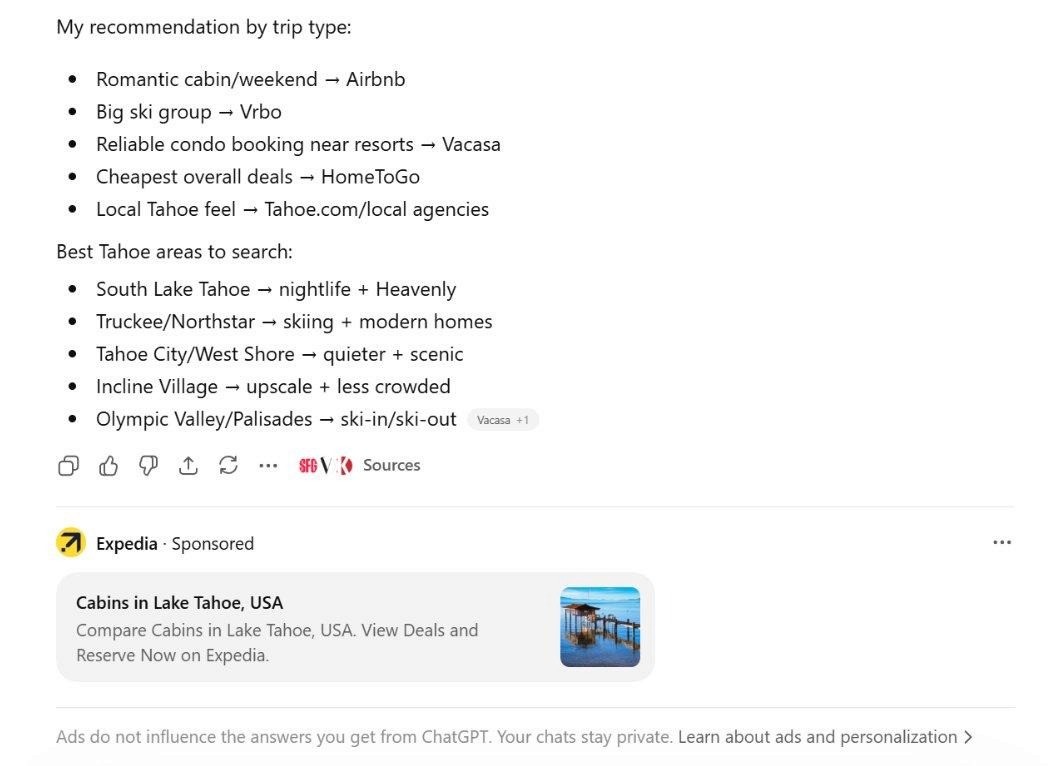
ChatGPT response on Lake Tahoe cabins with Expedia sponsored ad
The Expedia ad deep-links to a Tahoe cabins search results page with destination and lodging type pre-populated.
Query: "best beach resorts in Florida"
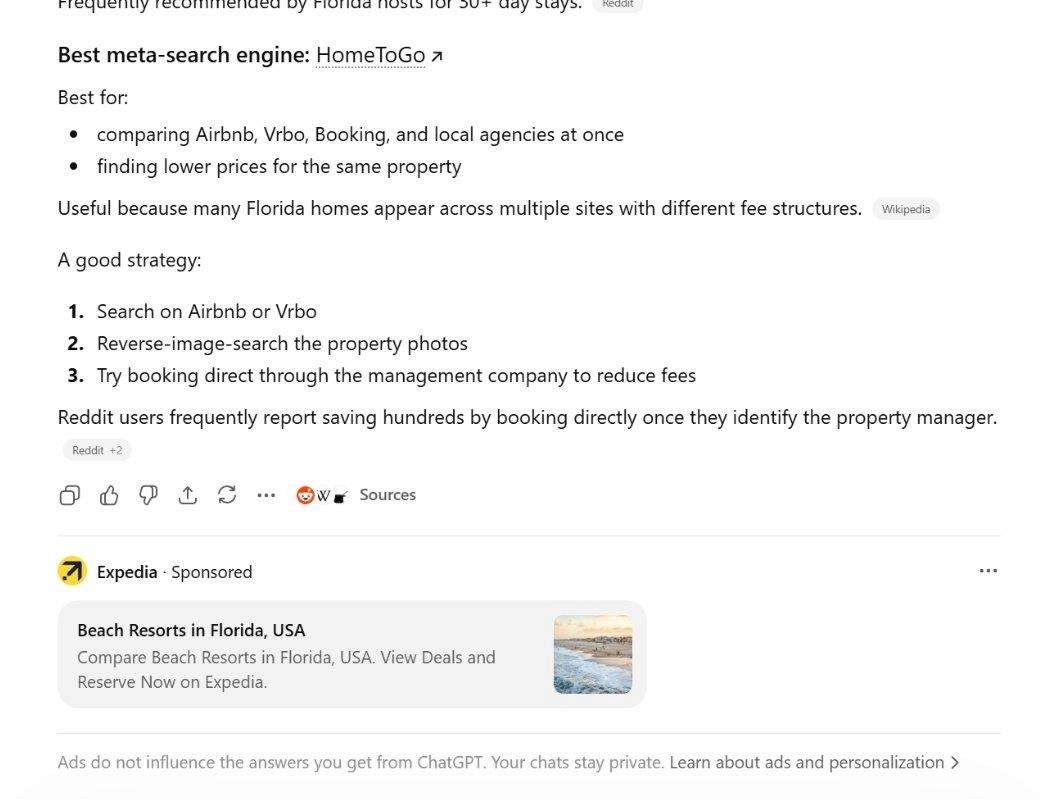
ChatGPT response on Florida beach resorts with Expedia sponsored ad
The ad deep-links to a Florida beach resorts LP with region and lodging type pre-populated.
Query: "best vacation rentals in the Blue Mountains"
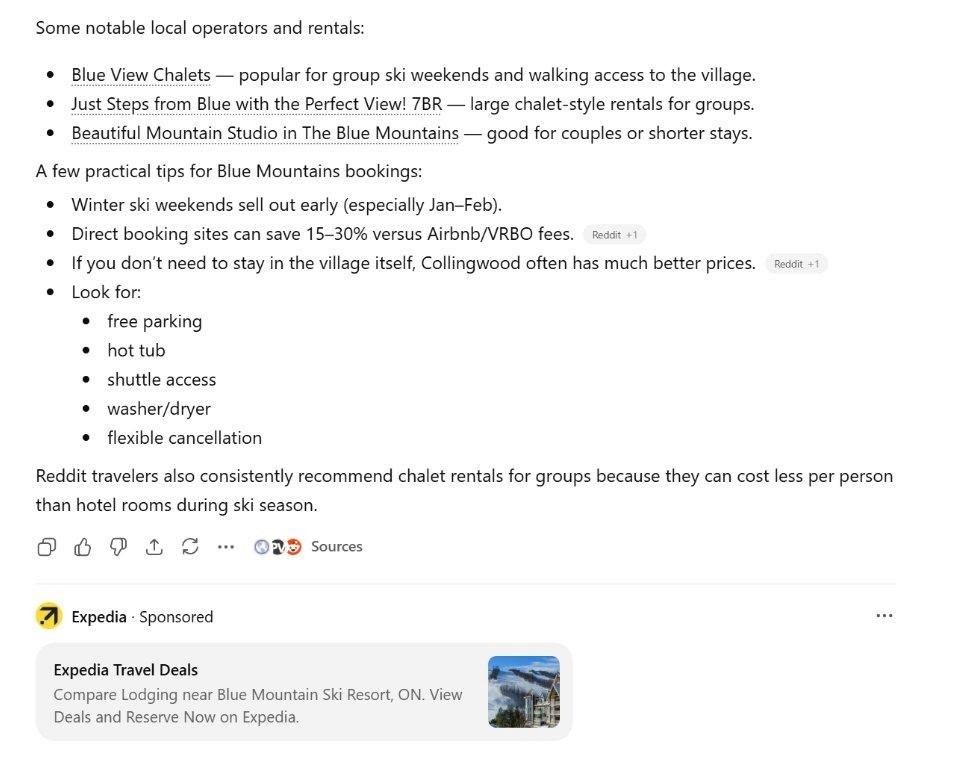
ChatGPT response on Blue Mountains rentals with Expedia sponsored ad
The ad deep-links to lodging near Blue Mountain Ski Resort, Ontario.
Query: "best all-inclusive resorts in Puerto Vallarta"
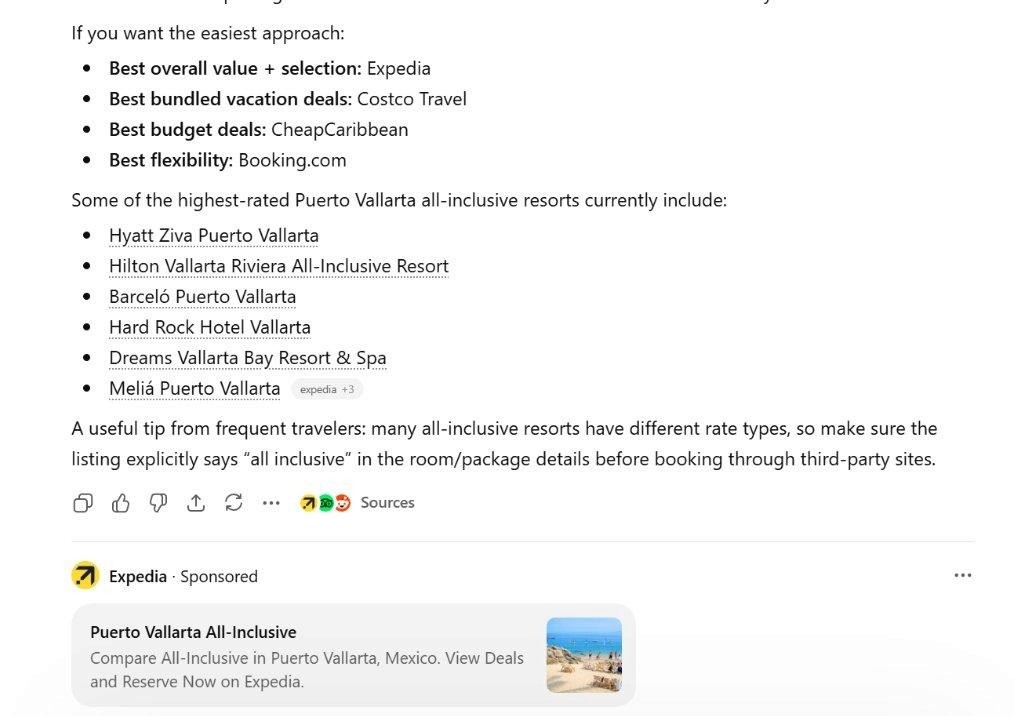
ChatGPT response on Puerto Vallarta all-inclusive resorts with Expedia sponsored ad
The ad deep-links to an all-inclusive search in Puerto Vallarta.
When the destination is narrow, the LP can match at property-type level instead of destination level
Query: "boutique B&Bs in Northern Portugal"
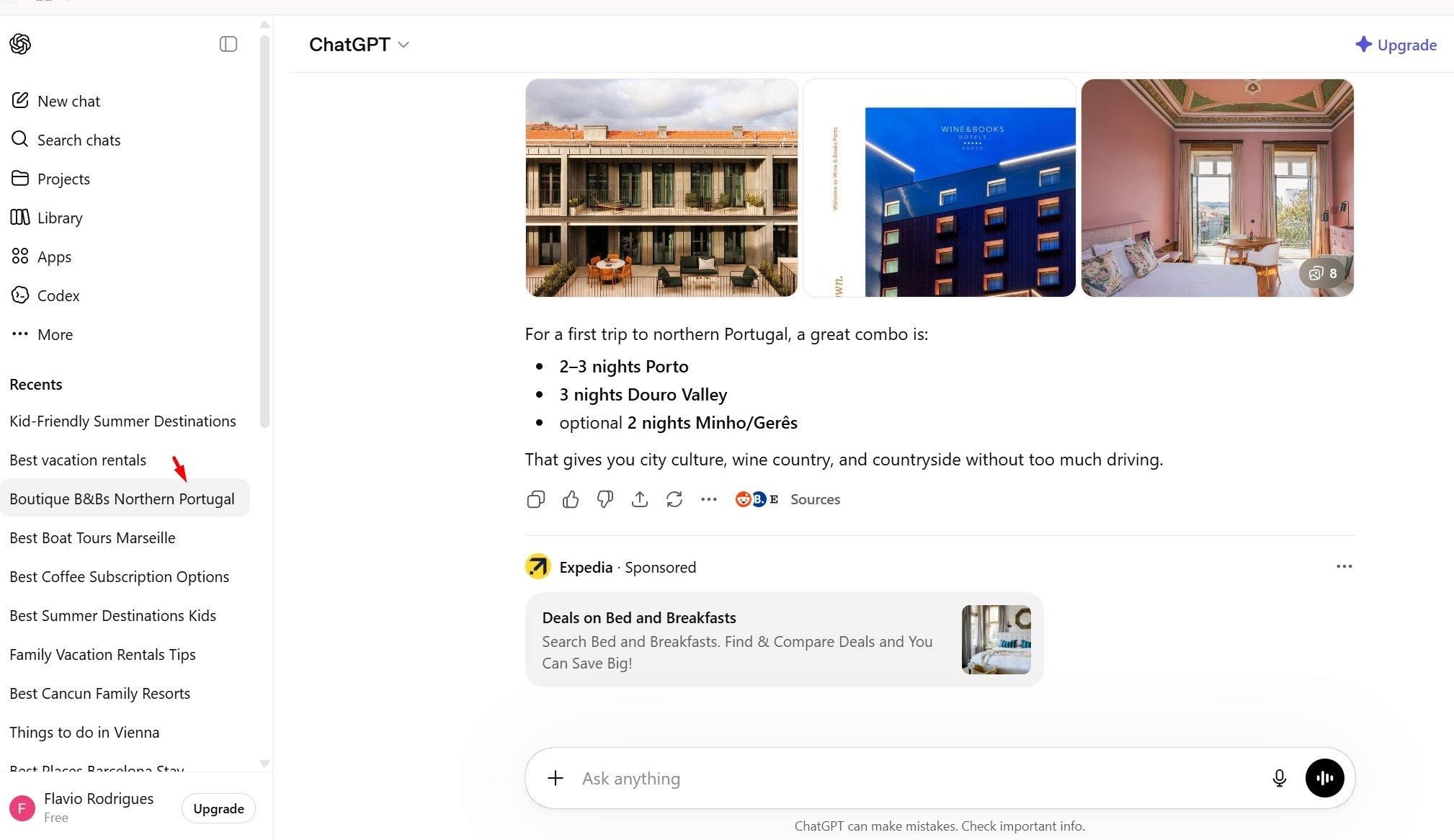
ChatGPT response on Northern Portugal B&Bs with Expedia generic B&B deals ad
Destination plus property type, but a narrow destination. The Expedia ad shows up, but the LP is property-type focused ("Deals on Bed and Breakfasts") rather than destination-parameterized. Matching depth scales with Expedia's LP inventory for that combination.
When the query is destination only, the ad is destination-tailored but loses property-type and amenity specificity
For queries like "When is the best time to visit Porto" or "things to do in Vienna," the Expedia ad and LP are both tailored to the destination (Porto, Vienna), but at the destination level only. No property-type or amenity specificity in the LP.
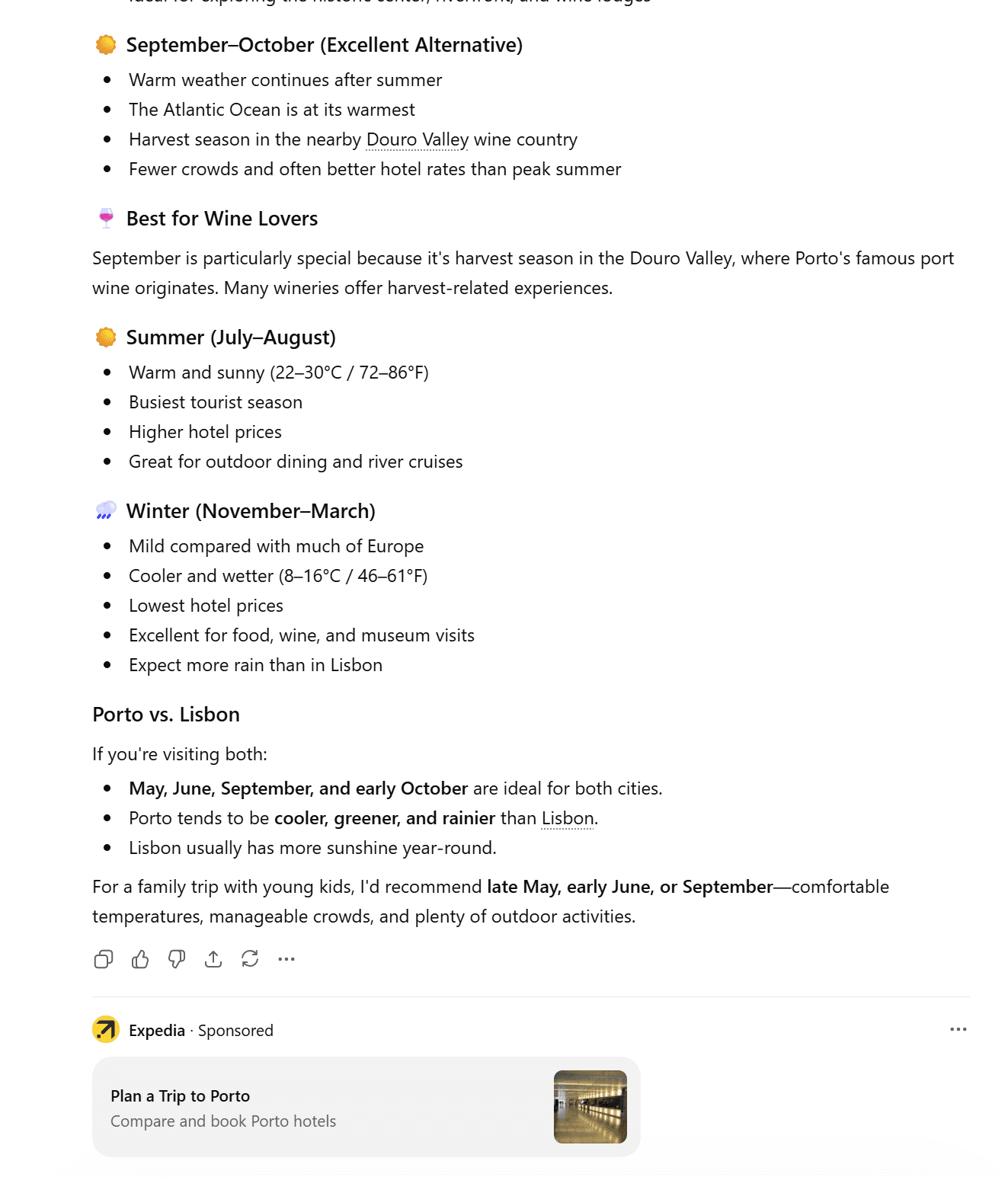
When the query is pure exploratory, no ad fires at all
Query: "kid-friendly summer destinations"
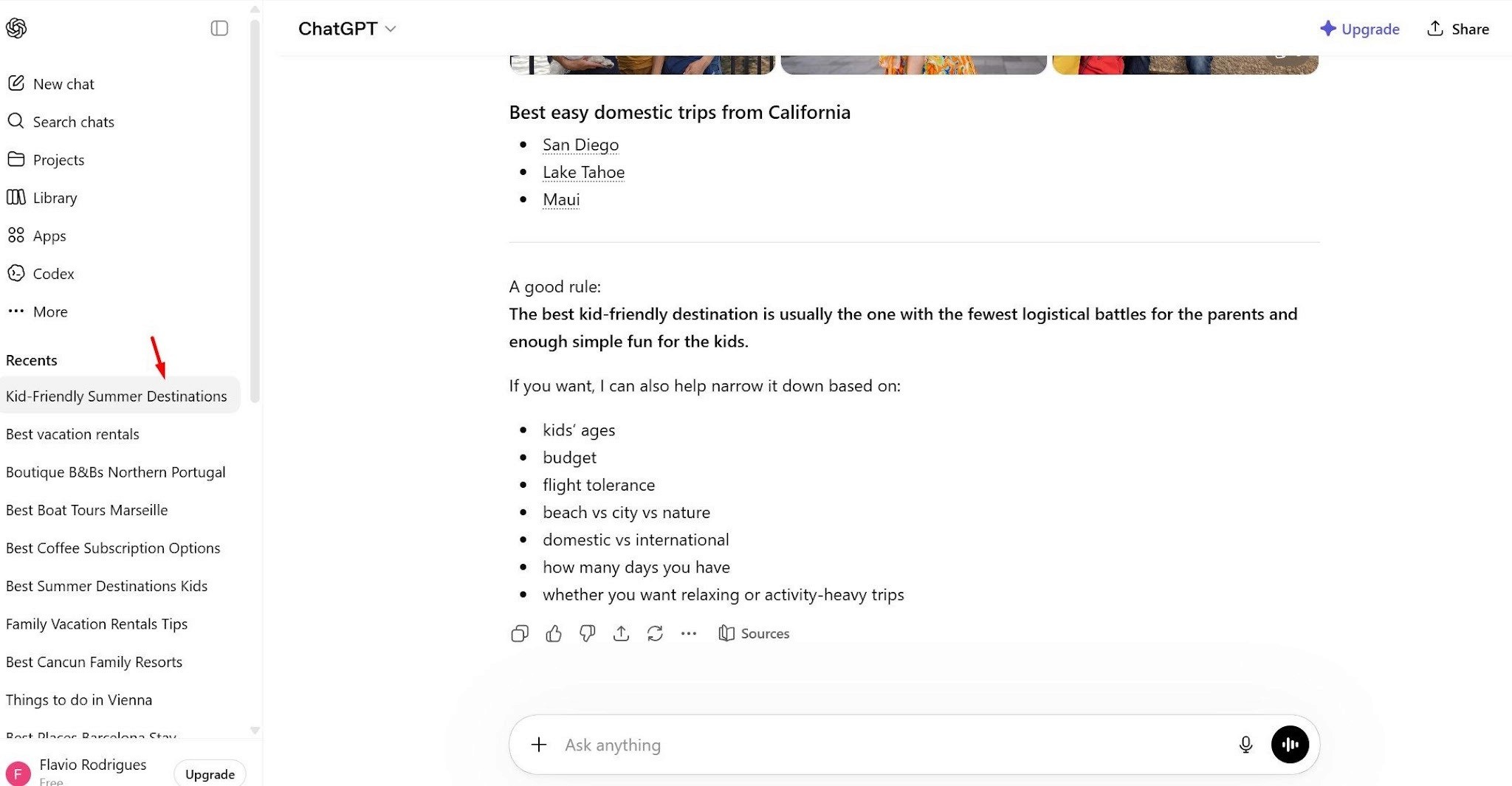
ChatGPT response on kid-friendly summer destinations with no ad
No destination. No property type. No sponsored ad.
Query: "best vacation rentals"
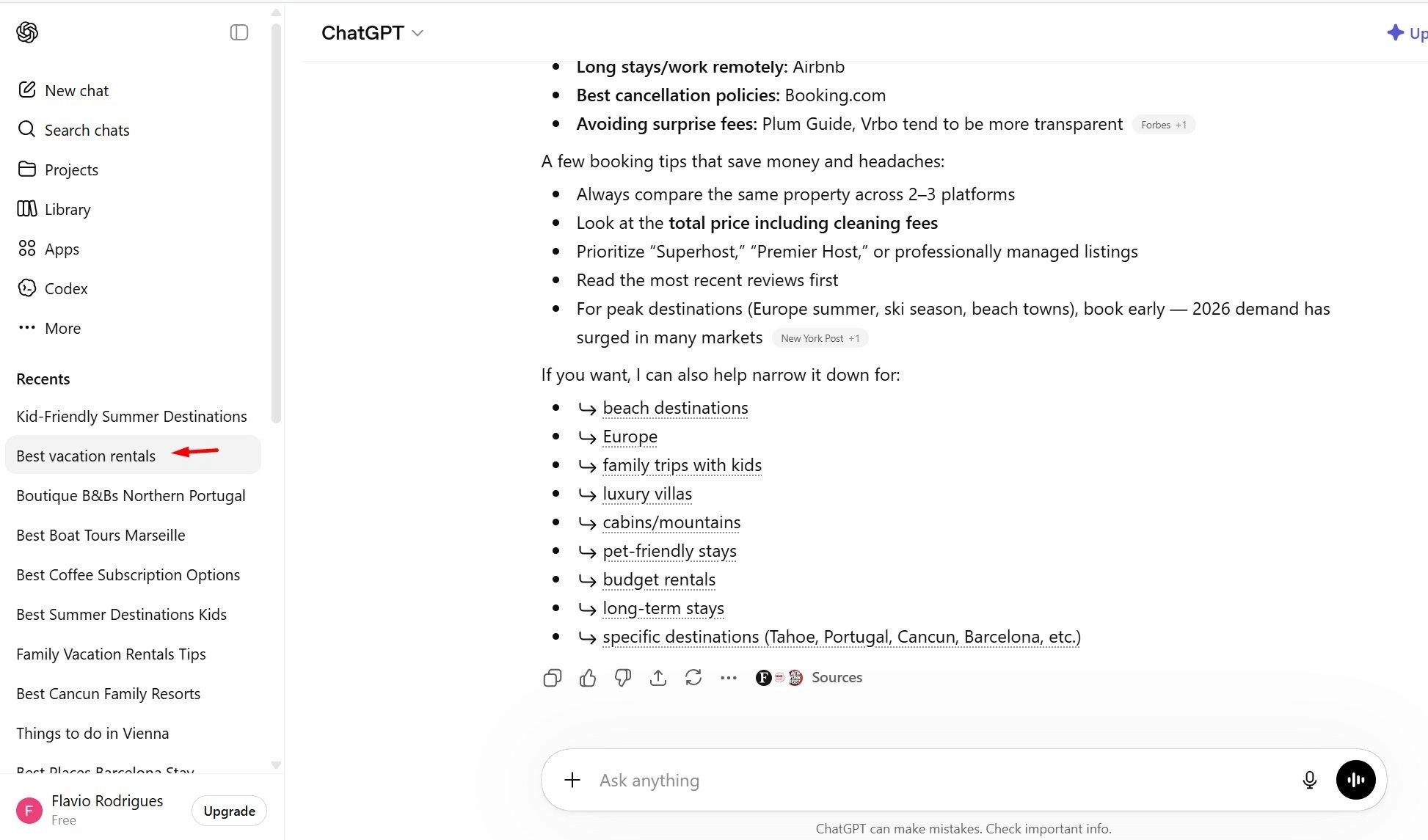
ChatGPT response on best vacation rentals with no ad
Property type only, no destination, no qualifier. Again, no ad.
The pattern resolves into three tiers
Specific destination plus property type ("cabins in Lake Tahoe," "beach resorts in Florida," "all-inclusive resorts in Puerto Vallarta," "vacation rentals in the Blue Mountains") triggers a tailored Expedia ad with deep-linked parameterized LP.
Destination only, no property type ("things to do in Vienna," "best time to visit Lisbon") triggers a destination-tailored ad and LP, but with no property-type or amenity specificity.
Pure exploratory, no destination and no property type ("kid-friendly summer destinations," "best vacation rentals") triggers no ad at all.
The negative space is real, and the gradient between specificity tiers is where the discipline lives. What Expedia is doing, and pointedly not doing, is the most interesting thing happening on this platform right now for travel brands.
What Expedia is doing that travel brands need to study
The obvious thing is that Expedia's landing page matches the ad: destination, lodging type, and dates pre-populated. But that's table stakes. Any advertiser with parameterized URLs deep-links like that on every platform. It's not the story.
The story is the campaign architecture. Expedia is matching at the destination plus property-type level, and the depth of the match scales with the specificity of the query.
That gradient is the insight. Expedia isn't trying to be present for vague, exploratory, top-of-funnel travel curiosity. They surface only when the query already contains a destination AND a property type, when the user is one decision away from a booking. They're treating ChatGPT Ads as a precision long-tail intent tool, not a reach or awareness channel.
Look at the mechanism. The pattern strongly suggests Expedia has plugged their existing Dynamic Search Ads feed (destination × property type × amenity, the exact infrastructure that's run their long-tail Google Ads campaigns for over a decade) into the ChatGPT context-hint system, adjusted for the new surface, and let it run. There's no new creative strategy here. No conversational marketing reinvention. They're porting proven automation to a new front door. From the outside it looks like the lowest-friction, highest-leverage version of "no new playbook" you could build.
The destination URLs themselves confirm this. The Lake Tahoe cabins ad routes to an Expedia LP with URL parameters regionId=652645981589159936, lodging=CABIN, destination=Lake Tahoe, plus pre-populated check-in and check-out dates. The Florida ocean-view ad routes to a URL with regionId=211, lodging=HOTEL_RESORT, amenities=OCEAN_VIEW, destination=Florida, again with dates pre-populated. That's the destination × lodging type × amenity × date matrix made literal in the URL structure. It's exactly what a DSA-style feed produces, and it tells you the campaign architecture isn't an interpretation. It's the architecture in plain sight.
The URLs also carry a telling tracking parameter: semcid=US.UB.OPENAI.DT-c-EN.HOTEL. The OPENAI segment of that string is Expedia's internal channel taxonomy explicitly labeling ChatGPT as a tracked acquisition channel inside their attribution stack. You don't build channel-level tracking instrumentation like that for a casual test. You build it when the channel is part of your real media mix and you intend to attribute revenue against it. Expedia isn't experimenting here. They've operationalized.
The part that should stop every travel marketing team
Across several dozen commercial and non-commercial travel queries I ran from a California-based test account, the pattern is striking. In lodging, Expedia is effectively unopposed. Across hotel, resort, cabin, vacation rental, and B&B queries, Expedia is the only advertiser running ads at all. Not "the only major one." The only one, period. No Booking.com. No TripAdvisor. No Airbnb. No Agoda. No Hotels.com. No Vrbo. No Marriott. No Hilton. No boutique OTAs. No metasearch. Nothing. Not on "all-inclusive resorts in Cancun." Not on "vacation rentals in Tahoe." Not on "best places to stay in Barcelona." Not on "cabins in Gatlinburg for big families." Not on the broad exploratory queries either.
Outside lodging, the picture is even emptier. Car rental queries returned no ads. Cruise queries returned no ads. Ski resort and tour queries returned no ads. The one travel sub-vertical outside lodging where I found any advertiser at all was flights. And there, across every flight query I tested, the only ad surfaced was from a single boutique business-class deals aggregator, Business Travel Group LLC, running on a generic "SFO to Europe" routing query.
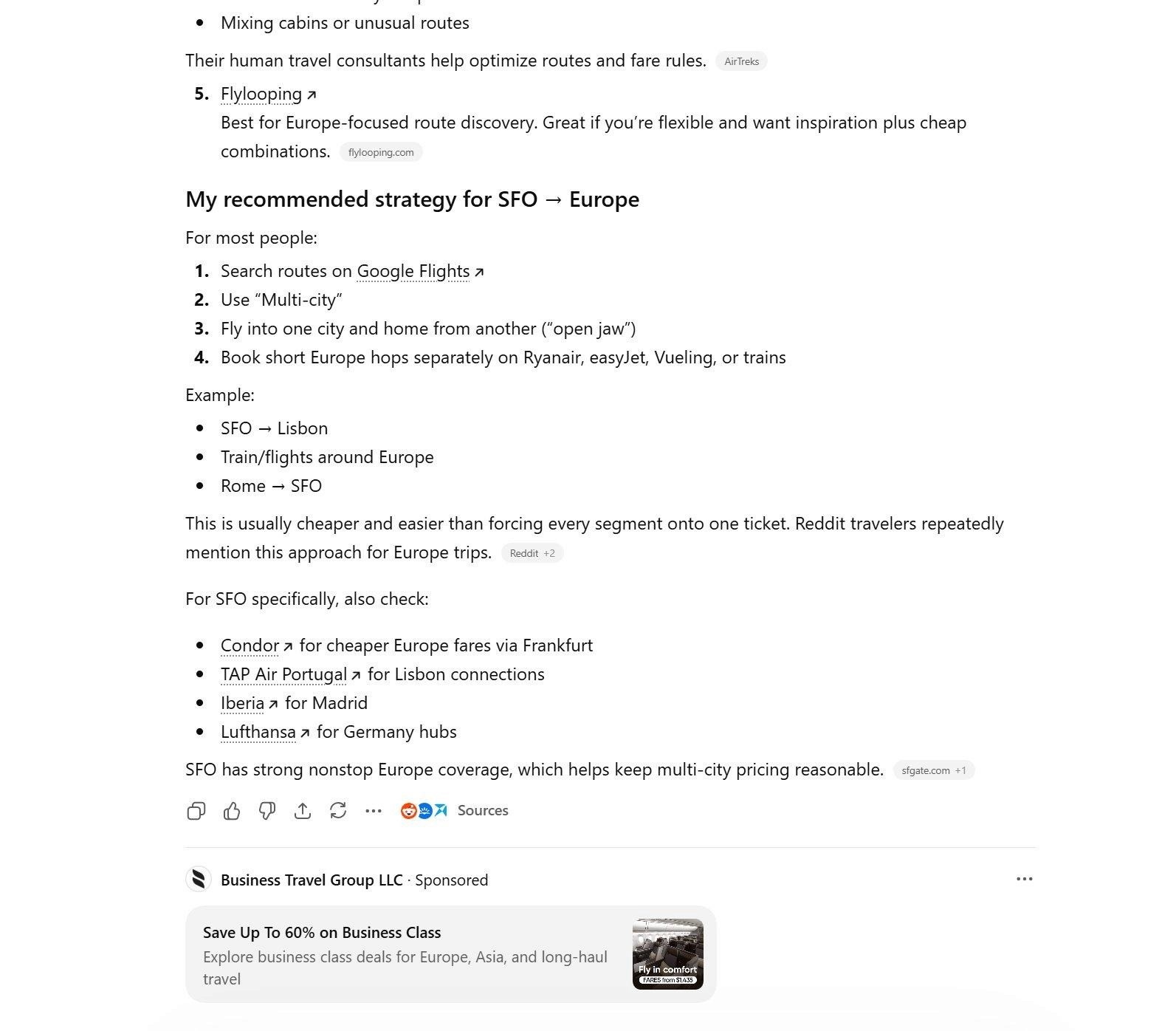
Business Travel Group LLC business-class flight ad on a ChatGPT response about SFO to Europe routing
That single exception is not a counter-example to the rest of the pattern. It's the cleanest possible illustration of it. Hold that finding for a moment. I'll come back to it when I lay out the economic math below, because it tells you almost everything you need to know about which travel brands can plausibly run this channel today.
And here's what makes the lodging observation more interesting than it first looks. The ChatGPT responses themselves recommend multiple travel brands by name when you ask category-defining questions. Ask about Puerto Vallarta all-inclusive and the response writes "Best overall value + selection: Expedia. Best bundled vacation deals: Costco Travel. Best budget deals: CheapCaribbean. Best flexibility: Booking.com." Same in Lake Tahoe (Airbnb, Vrbo, Vacasa, HomeToGo named). Same in Florida (HomeToGo, Airbnb, Vrbo, Booking named). Same in "best vacation rentals" (Airbnb, Vrbo, Booking, Plum Guide named).
A caveat is in order here. The organic recommendation layer in a ChatGPT response is a separate system from the ad auction. Two different models, two different outputs. The fact that the AI surfaces Booking and Airbnb organically does not, on its own, prove anything about why those brands are or are not in the ad auction. What it does establish is that the major travel brands are present in the AI's category awareness. That makes their advertising absence a question worth asking rather than dismissing.
So why aren't they running ads? A few plausible answers, none of them complete on their own:
Channel skepticism. Some performance teams will look at the $3 floor CPC, the absence of Max Conversions bidding, the lack of audience layering, the limited reporting depth, and conclude that the channel isn't ready to scale. That's a defensible read in 2026, and many big-brand performance teams default to "wait and see" on new auctions until the infrastructure matures.
Head-start asymmetry. Expedia almost certainly entered as a managed launch partner during the February-to-May 2026 window when the self-serve platform did not yet exist. That's roughly three months of head start on infrastructure, attribution, context-hint testing, and channel learning. Brands entering through self-serve in May or June 2026 are not entering a level auction. They're catching up against an operator who has been on the surface for months. Whatever exact terms Expedia received, the time gap alone is meaningful.
Strategic posture. Some of the missing brands have philosophical reasons for sitting out direct-response auctions. Airbnb in particular has spent years explicitly de-emphasizing performance marketing in favor of brand investment. Their absence here is consistent with how they think about paid channels in general, not a surprise about this specific surface.
Operational lag. Decisions to spin up a campaign on a new channel at companies the size of Booking, Marriott, or Hilton involve more than one approval, more than one quarter of budget reallocation, and more than one team's roadmap. Self-serve opened roughly six weeks ago. Most enterprise advertisers are still in evaluation.
What none of these reasons is, individually or together, is budget. Booking, Airbnb, Hilton, Marriott, and the other absent global travel brands have the financial capacity to put a few million dollars into a buzzy new channel for testing purposes. For companies their size, that is rounding error on a quarterly media budget. So whatever is keeping them out, it is not the cost of the bet.
The net effect, regardless of which combination of reasons is operative, is the same. Expedia is running unopposed in the lodging category on ChatGPT Ads. The most sophisticated travel advertiser in the world is the only one in the room. That's not an "early opportunity" in the generic early-mover sense. It is a structurally vacant auction in one of the highest-intent ad surfaces a travel brand will access this decade, and the brand that figured it out first is operating without competition while the rest of the industry sorts out its 2026 channel strategy.
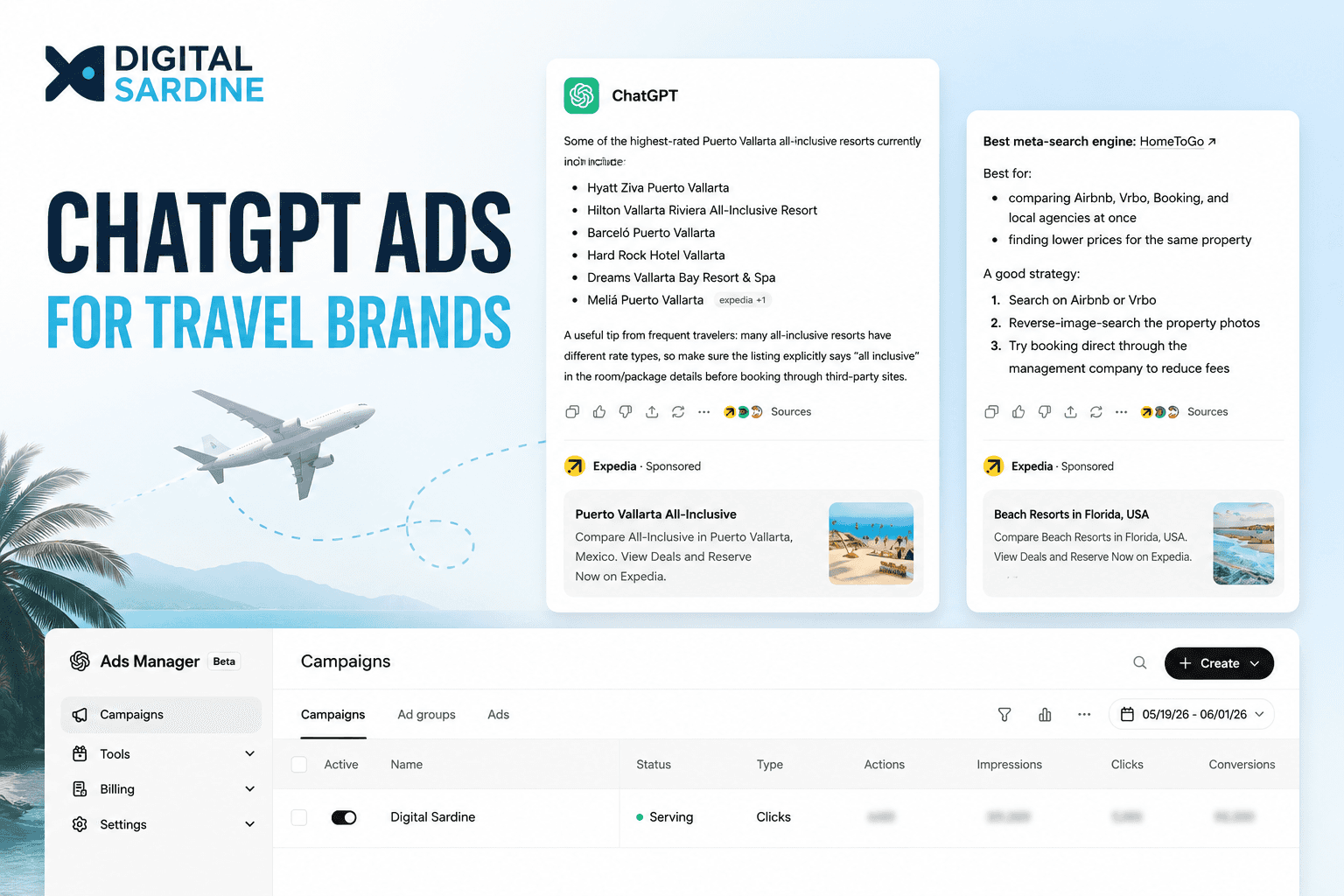
What this means for the dominant narrative
This kills the dominant take on ChatGPT Ads. Most coverage frames the platform as an "influence layer," a place to shape consideration before the search happens, to intercept demand early. Expedia, the most sophisticated travel advertiser on the platform, is doing the exact opposite. They're capturing near-purchase intent and deliberately ignoring everything broad. The smartest money in the room is treating this as bottom-funnel, not top.
And here's what should reassure every travel marketer reading this: there's no new playbook. Expedia isn't doing conversational marketing or AI-native influence or anything you need a new framework to understand. They're running the same high-intent, long-tail paid search discipline they've run for fifteen years (destination plus property type, matched at the moment of intent) on a new surface. The lesson isn't "learn a new channel." It's "the channel you already know how to win just opened a new front door."
Four things this tells us about how ChatGPT Ads work for travel
1. Specificity wins the auction, and breadth gets nothing. The relevance-weighted auction appears to reward tight alignment between the context hint and the query. Generic context hints ("travel," "vacation," "hotels") either don't trigger or don't convert. Expedia's media team has clearly concluded it's not worth bidding on them. The architecture to copy is a matrix of destination × property type, not a single broad "travel" campaign.
2. Your context hints should be written as destination plus property-type combinations. Not keyword stems. Not categories. Context hints are plain language at the ad-group level and don't function as exact-match keywords, but the granularity Expedia is hitting ("cabins in Lake Tahoe," "beach resorts in Florida") tells you the resolution at which this platform actually matches. Write hints at that level.
3. The conversion path is collapsed by design. Once you've matched a specific destination plus property-type query, the parameterized LP (dates pre-filled) and the "Book now" CTA carry the user from conversation to booking in a single click. The LP matching isn't the clever part. It's the necessary downstream of the clever part. The cleverness is upstream, in the decision to only show up for queries that are already that specific.
4. Your DSA feed is probably most of what you need. If you already run dynamic search ads on Google with destination × property-type × amenity coverage, the structural work to run ChatGPT Ads in the same shape is mostly already done. Adapt the context hints to read like conversational phrasing, route them at the parameterized LPs you already have, and you're 80% of the way there. The brands that don't have the DSA infrastructure are the ones with real catch-up work, and almost none of Expedia's competitors are even at the starting line.
How the ad-matching mechanism actually works
When I first observed the three-tier pattern, I hypothesized that the ad was being matched against the AI's response, not the user's question. The reasoning seemed clean: the AI generates an interpreted intent from the query, and it would be elegant for the ad system to match against that interpreted intent.
I tested it. The data doesn't support it.
The cleanest disproof is the "kid-friendly summer destinations" query. The AI's response recommends San Diego, Lake Tahoe, and Maui by name, with descriptions and rationale for each. If the matching were happening against the response, an Expedia ad for any of those three destinations should plausibly fire. None does. The AI's recommendations don't drive the auction. The user's typed query does.
The simpler explanation is the correct one. Ads match against the query the user typed, not the response the AI generated. The match depth scales with the specificity of the query itself. Destination plus property type triggers a fully parameterized ad. Destination only triggers a destination-tailored ad. A query containing neither triggers nothing, regardless of what the AI says in response.
This reinforces the "no new playbook" thesis rather than complicating it. The matching layer is functionally similar to keyword targeting in Google Ads, not some novel response-content matching system. Context hints work like keyword themes against the user's typed query. The exact mechanism that's run paid search for two decades is what's running here.
The practical implication for how to write context hints is now simpler. Write them to match how real users phrase their commercial intent: destination plus property type plus optional amenity, in plain language. Not how the AI describes things in responses. Not how SEO content is structured. How users actually type queries when they're close to a booking decision.
How the platform actually works (June 2026)
Here's a tour of what's actually inside Ads Manager Beta today.
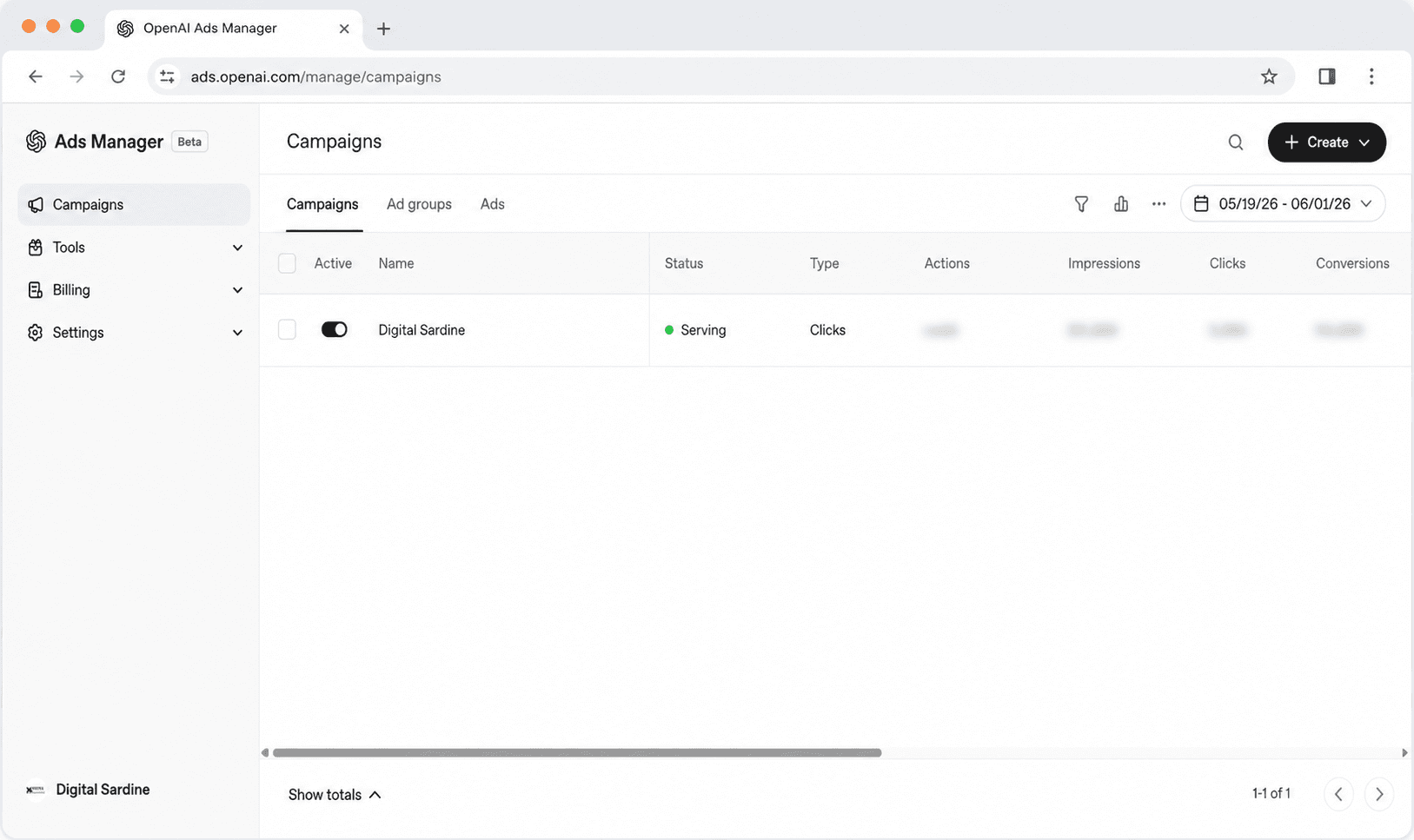
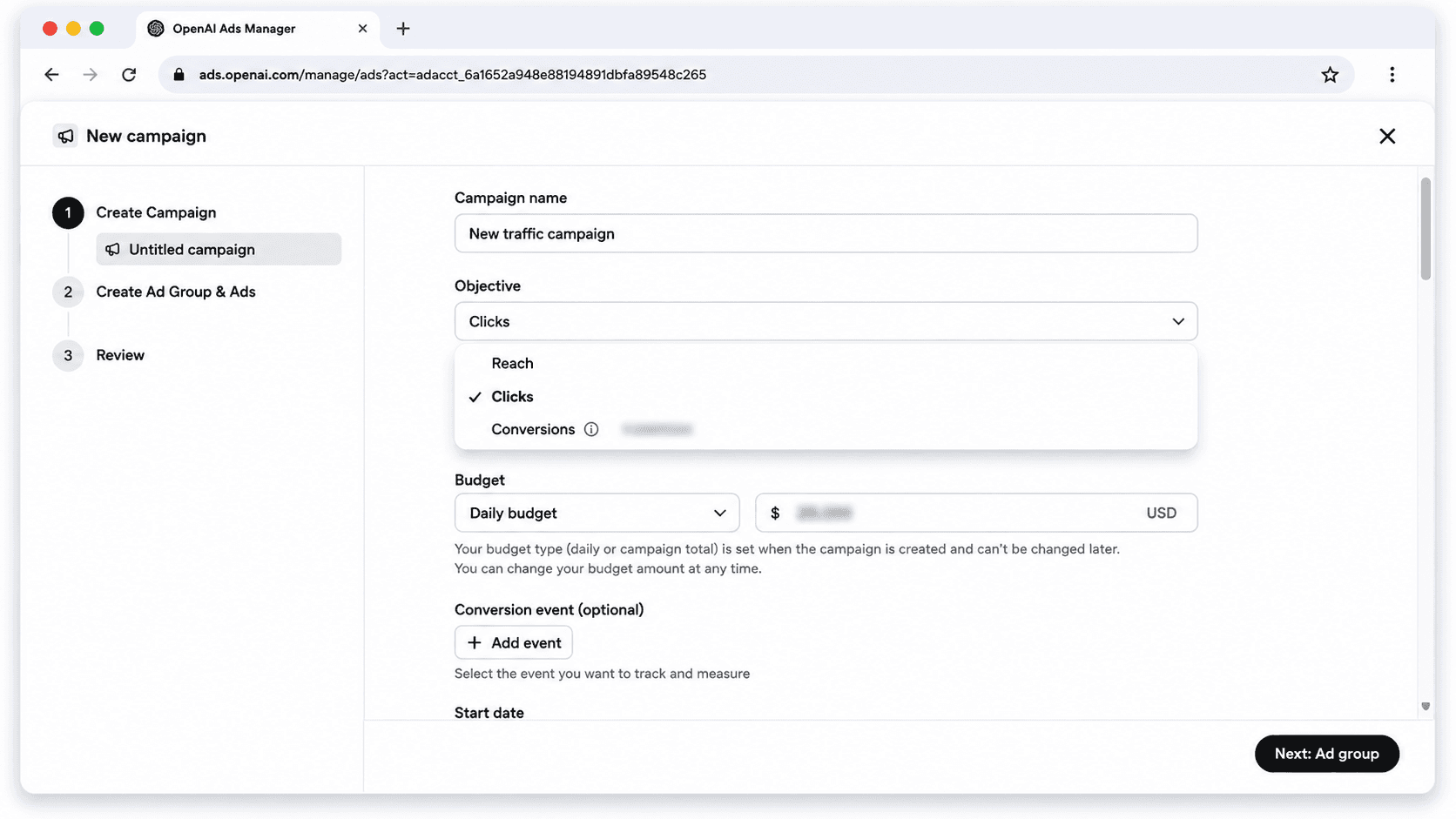
Where ads run: Ads serve to users in the US, Canada, Australia, and New Zealand. Self-serve Ads Manager Beta access is currently US-only for advertisers. UK, Brazil, Japan, South Korea, and Mexico are rolling out.
Who sees ads: Free tier and Go ($8/mo) tier users only. Plus, Pro, Business, Enterprise, and Education subscribers are ad-free. That matters when you model addressable reach. Your customer base may or may not skew toward the ad-eligible tiers.
What you can target: Geo at country, state, DMA, or ZIP level. Plain-language "context hints" at the ad-group level. That's the entire targeting stack. No demographics. No behavioral targeting. No interest segments. No lookalikes. No audience-building pixel for remarketing. Targeting is intentionally narrow and contextual.
How you can bid: Two campaign objectives: Clicks (max CPC) or Reach (CPM). No Max Conversions, no target CPA, no target ROAS. CPA bidding is in development. OpenAI's help docs frame $3 to $5 max CPC as a "recommended starting bid," but in practice $3 is the working floor. Bids below that effectively don't win impressions. Plan POC budgets accordingly: you're committing to roughly $3 per click minimum, and you need at least a few hundred clicks before you have signal. CPM default is $60 max, with observed clearing rates closer to $25 in some categories.
How you measure: Conversions API and pixel-based attribution went live April 30, 2026. You can measure conversions from ChatGPT Ads. You just can't tell the platform to bid toward them yet. Reporting includes impressions, clicks, spend, CTR, average CPC, average CPM, and conversions, aggregated, with no individual conversation data flowing back to the advertiser.
One platform behavior worth flagging: Ads only show on new conversations and don't persist. Starting a new session eliminates ads from previous conversations immediately. Even reopening a past conversation and posting a new comment in it doesn't re-trigger any ad. The pattern held across every old conversation I checked.
Caveats: this is from a free account, on browser (not the app), in a California-based setup. Different combinations (app vs. desktop, account tier, geo) may produce different behavior. Worth verifying for your own context before you bake it into a forecast.
The implications are real. You can't rely on a user returning to the same chat to re-encounter an offer. There's no multi-touch journey across a single conversation thread. Attribution windows matter more, because the ad impression is genuinely a one-shot event. And the screenshot-the-ad-and-share-it behavior that drives some viral discovery in other channels won't work the same way here, because users would need to recreate the conversation to re-trigger the ad.
Eligibility for travel: Travel and experiences is in the auto-eligible category tier. You can apply for an account, get approved, and run ads without case-by-case review. This is the easy door, and it's why Expedia is already inside it. Other auto-eligible categories include household and consumer goods, local services, digital products, and education.
How travel brands should think about testing today
The practical version, if you're deciding whether to test now:
Before anything else: does the math even work for your brand?
Floor CPC is $3. Industry-benchmark paid search CVR for travel sits around 2% for well-optimized accounts (better for some segments, worse for others, but 2% is a defensible starting point). That math gives you a rough cost per booking of around $150.
If your margin per booking is $30, you're at 20% ROAS. You're buying revenue at a loss. This channel does not work for you, full stop.
If your margin per booking is $200, you're at roughly 133% ROAS. The channel pays for itself with margin to spare. This is where the math starts to work.
The 2% CVR assumption is one of the things my POC will refine. Conversational referral could convert higher than Google Search traffic (the user is one decision from booking, the AI just recommended the category to them) or lower (research-mode users might not convert as cleanly). The benchmark gives you a conservative starting gate. Real numbers will come from real campaigns over the next 30 to 60 days.
This is, incidentally, part of why Expedia is alone in lodging on the platform. Their effective margin per booking, especially on bundles and packages, clears that math comfortably. Most thin-margin OTAs, low-AOV property categories, and metasearch arbitrage businesses can't justify $150 CAC. The unit economics gate the entire opportunity. The brands that can play here are the ones with high-margin booking products: premium experiences, luxury and full-service hotels, multi-night packages, tour operators with margin per traveler, and OTAs with strong attach economics on insurance, car rentals, and extras.
It's also why the one travel advertiser I found outside lodging, Business Travel Group LLC, is selling business class specifically. Economy flight margins are notoriously thin, often a single-digit percentage of fare and sometimes negative once distribution costs are factored in. They cannot clear $150 CAC. Metasearch and travel arbitrage businesses like Kayak, Skyscanner, and Trivago run on per-click spreads of $1 to $3 between what they pay for traffic and what they earn from outbound referrals. The $3 floor CPC breaks that model on impact. Business class margins are large enough to clear the math, and that's exactly the segment the one flight advertiser is selling into.
A side note on this. The economic gate cleanly explains the flight category, where airlines and metasearch are absent because the math forces them out. It does not cleanly explain the lodging category. Booking and Airbnb have take rates and AOV that should plausibly clear $150 CAC. Their absence from lodging is something else: channel skepticism, operational lag, strategic choice not to chase Expedia into a managed-partnership channel, or something not visible from outside. Whatever it is, Expedia has the field to themselves while the math decides who can even step on it elsewhere.
If the math doesn't work, none of the operational guidance below matters yet. Wait until either your AOV/margin profile changes or the platform's effective CPC comes down.
If the math works, test today if you have:
LP infrastructure that supports long-tail intent: destination-specific, lodging-specific, amenity-specific URLs with parameter handling
Conversion tracking already wired into your booking funnel
Budget for a real POC: $3K to $5K minimum to generate meaningful click volume at floor CPC
A defined audience segment that maps to specific conversational query types ("cabins in Tahoe," "beach resorts in Florida," "family-friendly resorts in Cancun")
Wait 30 to 60 days if you have:
Only a homepage LP or generic category pages
No conversion tracking on the booking funnel yet
A test budget under $2K. The auction floor will eat it before you learn anything meaningful.
Things to test specifically:
Granular vs. broad context hints. Build one ad group with destination plus property-type hints ("cabins in Lake Tahoe," "beach resorts in Florida") and one with broad hints ("vacation rentals," "hotel deals"). My strong prior, based on what Expedia is doing: the granular group delivers and converts, the broad group barely serves. Prove it for your own destinations.
Whether hints written to mirror real user phrasing ("best cabins in Lake Tahoe for a family of four") outperform keyword-style hints ("Lake Tahoe cabin rental")
Whether parameterized LPs outperform category LPs on the traffic you do capture
Whether "Book now" CTAs outperform "Learn more" for hotel and tour operator brands
How conversational referral conversion rates compare to Google Search referral conversion rates, holding LP constant
What's not there yet (and what it means)
Honest list of what's missing today:
No Max Conversions, tCPA, or tROAS bidding
No audience layering (no demographics, behavior, interests, lookalikes)
No remarketing
No query-level reporting. You can't see which conversational queries triggered your impressions.
Self-serve Ads Manager Beta still US-only for account creation
Reporting is aggregated; no individual conversation context flows back
That gap will close. CPA bidding is in development. Reporting is getting deeper with each release. International self-serve is rolling out.
The practical implication for travel brands: the platform is mature enough today to run a real long-tail intent capture test with parameterized LPs. It is not mature enough today to be a primary acquisition channel, and anyone telling you it is hasn't been inside it.
What I'm testing first
I'm starting a first ChatGPT Ads campaign with one client this month and evaluating fit across the rest of my existing roster based on eligibility and the unit economics above. Most brands that pass eligibility won't pass the math, and that's fine. The point of running a test isn't to confirm the platform works in general. It's to confirm it works for your margin profile, at the CVR you actually deliver, on the LP infrastructure you actually have.
There's a useful outside signal worth noting. Neil Patel published an Adthena-sourced index of 580 observed ChatGPT ads in May 2026. The top five advertisers by volume: Lowe's (25 placements), Nordstrom (22), Best Buy (20), Liberty Mutual (12), and Insurify (10). Retail and insurance brands, every one of them with mature paid-search infrastructure and a long history of long-tail intent capture on Google. The top 10 advertisers account for 32% of all observed placements; another 23% sit in the top 11 to 25; 36% are one-time testers who showed up once and never returned.
Patel frames this as the market being "wide open," early opportunity to claim territory before the auction tightens. That framing is fine, but it understates the more interesting pattern. The story isn't how empty the market is. The story is who's winning. The early winners are exactly the brands you'd predict if this is high-intent paid search discipline ported to a new surface: established performance advertisers who already know how to run granular query-to-LP campaigns at scale. The 36% of one-time testers are most likely the brands that approached this as something new, didn't apply their existing paid search discipline to it, and got nothing back.
Worth flagging directly: Expedia isn't in Patel's top five. That's consistent with the architecture observation above, not in tension with it. Surgical destination plus property-type targeting produces fewer total ad observations than broad retail or insurance campaigns. Adthena's 580-ad index is a sample, not exhaustive, and travel-vertical queries are almost certainly under-represented in it. Different strategies, same underlying discipline.
The two questions I'm working to answer through the upcoming campaign:
How does context-hint granularity affect delivery? Does writing hints at the destination plus amenity combination level (the Expedia approach) significantly outperform broader category-level hints? My strong prior is yes.
How does conversational referral traffic convert relative to Google Search referral traffic, holding the LP constant? This is the question every travel CFO will ask once you propose a budget for this channel. It's also the assumption underneath the economic gate above. Real numbers replace the 2% benchmark in 30 to 60 days.
I'll publish what I find, including the things that don't work. That post lands in roughly 30 days.
The bottom line for travel
ChatGPT Ads aren't a future channel. They're a current channel with a specific shape: conversational query, ad creative match, parameterized LP. Expedia has already figured this out and is running the play. The discipline is one travel performance teams already have.
If you have the LP infrastructure to take advantage of long-tail intent matching, the time to learn this channel is now, before CPA bidding lands, before reporting deepens, before the auction tightens with new advertisers, and before the cost of being late shows up in your acquisition numbers. Not because everyone else is asleep, but because the platform is genuinely early and the people who learn its quirks now will run it better when it matures.
The question isn't whether to pay attention. It's whether you'd rather be early or late.




Featured contributor on the HubSpot

Sam Lauron Dec 14, 2023
When and How to Build International PPC Campaigns
“One-size-fits-all templates don’t work,” says Flavio Rodrigues, an SEM consultant who runs the consultancy, Digital Sardine. “There are differences in languages and dialects, currencies, user behaviors, and even payment methods,” he adds.