
I've spent the last month watching as much of this World Cup as I possibly could. As a Portuguese fan it ended in heartbreak. A 91st-minute Mikel Merino goal in Dallas, Spain 1-0, and with it the end of the road for what may be the most talented generation Portugal has ever produced, sent home in the Round of 16 without ever showing its true ceiling. It was also Cristiano Ronaldo's last World Cup match. Painful. The one sliver of consolation: Spain, the team that knocked us out, went on to beat Argentina in the final and lift the trophy, so at least we lost to the eventual champions.
But the tournament gave me something better than a Portugal run to root for. It reminded me that you can't teach resilience. Underdogs from Africa, Asia and the Middle East, squads full of players with ordinary lives and extraordinary belief, humbled superstars and historic giants. The image I can't shake is Vozinha, Cabo Verde's 40-year-old goalkeeper, a former electrician who was playing for Chaves in the Portuguese second division, standing on the biggest stage in the world, making seven saves to shut out Spain, the eventual world champions, and nearly toppling Argentina. His Instagram went from 50,000 followers to more than 17 million in days. The cheapest squad player Spain could name is probably worth more than Cabo Verde's entire team combined, and it didn't matter one bit. That is the magic of this sport.

I don't only watch the World Cup as a fan, though. I run travel PPC for a living, and while I was cheering I couldn't stop staring at the search data underneath the stories. Because when Cabo Verde qualified for the first time in October 2025 and then went on its Cinderella run, the islands got something no marketing budget can buy: months of global exposure. The search response was spectacular. It is also a trap, and understanding why is worth more than any "searches up 5,000%" headline.
So I pulled the demand data (aggregated Google flight-search demand, by origin country, April through early July 2026, with year-over-year comparisons against a clean pre-qualification baseline), then did the same for the host cities and every participating nation. Here is what a month of the world's biggest sporting event actually did to travel demand.
(The final has since been played. Spain beat Argentina 1-0 after extra time at MetLife Stadium in New Jersey on 19 July to win their second world title, their first since 2010. It changes none of the analysis below)
The spike is real, and beautifully timed
Flight-search demand for Cabo Verde sat flat for months at a baseline index of about 0.07. Then it detonated on match days. The opening 0-0 draw with Spain around 15 June pushed the index to 6. The knockout match against defending champions Argentina in early July drove it to 28, roughly 424 times the pre-tournament baseline. Demand tracked the fixtures almost perfectly, rising when Cabo Verde played and spiking hardest at the emotional peak of the story.
It's the cleanest natural experiment in demand generation I've seen in years. But the shape of the spike is only half the story. Where the demand came from is where most marketers will go wrong.
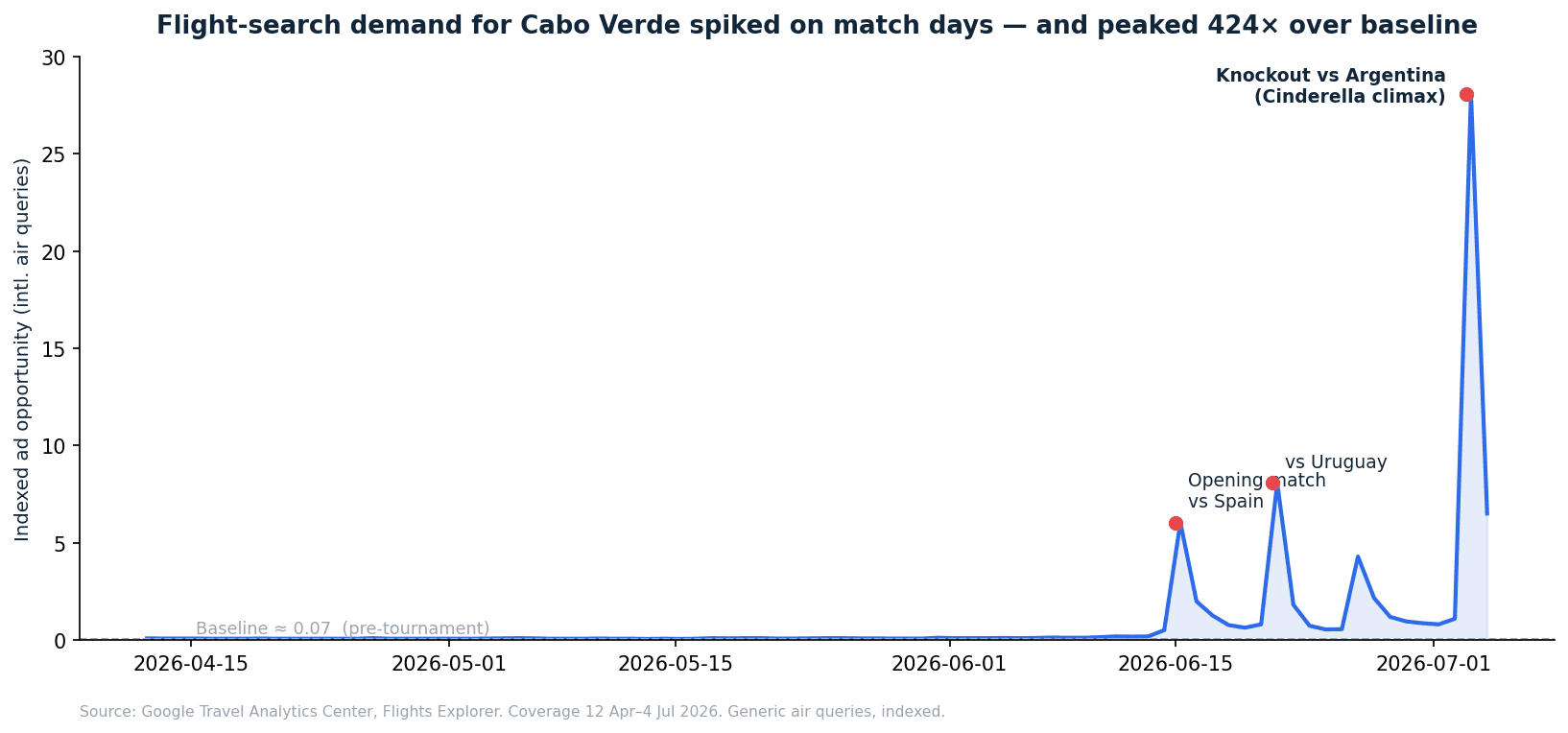
Caption: Flight-search demand for Cabo Verde was flat for months, then spiked on match days, peaking 424x over baseline during the Argentina knockout.
The trap: the surge is almost entirely non-convertible
The United States alone accounts for roughly two-thirds of all flight-search demand for Cabo Verde, up nearly 7,800% year over year. Add Canada and Mexico, the other two host nations, and the three hosts represent about 74% of total demand. The top four origins (US, Canada, India, Australia) reach 81%. Not one is a Cabo Verde package-holiday market, and there is no meaningful direct air access from any of them to the islands. This isn't booking intent. It's a global television audience Googling a place they just fell in love with.
Now the markets that actually send tourists to Cabo Verde, the UK, France, the Netherlands, Belgium and Portugal, make up only about 8% of total demand, and most are flat or falling year over year: the UK down 27%, France down 13%, Belgium down 13%, the Netherlands roughly flat, Portugal up a modest 6%. The only established feeders with real lift are Germany (up 50%), Spain (up 41%, no surprise, Cabo Verde played them), and the Nordics off small bases.
That's the whole point. The World Cup created enormous awareness precisely in the markets that can least convert it, and barely moved the markets that actually book. And the percentages flatter it further: even at its peak, Cabo Verde ranked around 97th of 249 destination countries by global inbound demand. A four-figure percentage increase on a tiny base is still a tiny base. Percentages seduce; absolutes decide budgets.
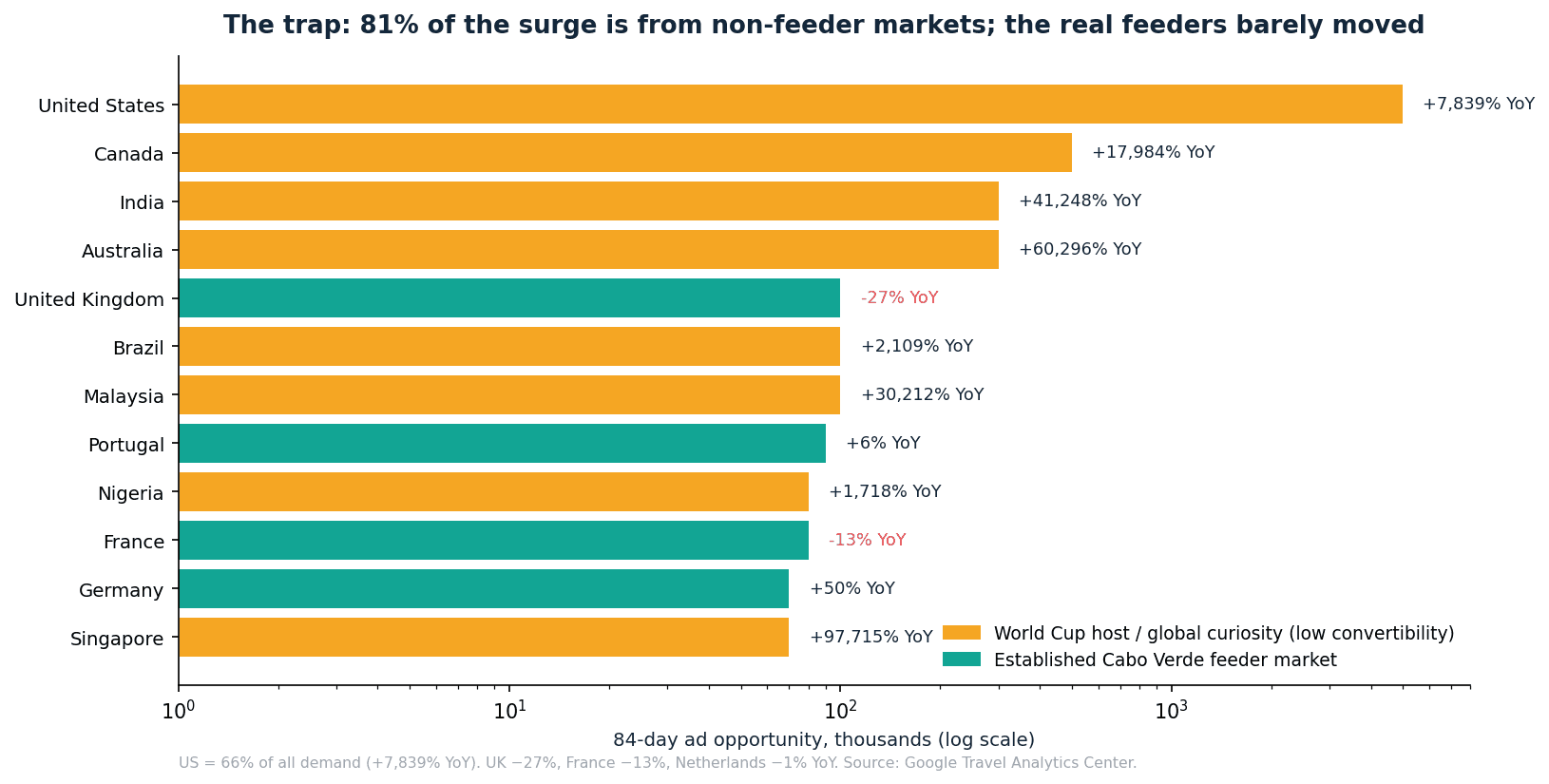
Caption: 81% of the surge came from non-feeder markets; the real feeder markets that actually book (UK, France) were flat or falling.
Hosting barely registered
The theory says hosting should light up demand in the host cities. I matched every 2026 venue to its region and compared inbound demand during the tournament against the prior period. The result is almost comical in its flatness. Host regions moved by a mean of 7.5%; non-host regions moved by 7.4%. Statistically, hosting a match was indistinguishable from not hosting one. On a volume-weighted basis the big host markets actually underperformed the rest of the country.
Look closer and it falls apart further. Every Mexican host region fell, Mexico City down 4.6% despite hosting the opening match. Miami dropped 15.8% while hosting. The host regions that did rise, New Jersey (up 34%, the final venue), Boston (up 25%), Seattle (up 20%), are precisely the northern markets that surge every summer anyway, right alongside non-host summer darlings with zero matches: Maine up 60%, Wyoming up 60%, Delaware up 54%. At the country level, US inbound demand rose a seasonal 5.8%, Mexico fell 11%, and only Canada showed anything. If hosting were a genuine demand magnet, you would not see the host nations collectively flat-to-down during the very weeks the tournament is played. The host signal is simply buried inside normal summer seasonality.
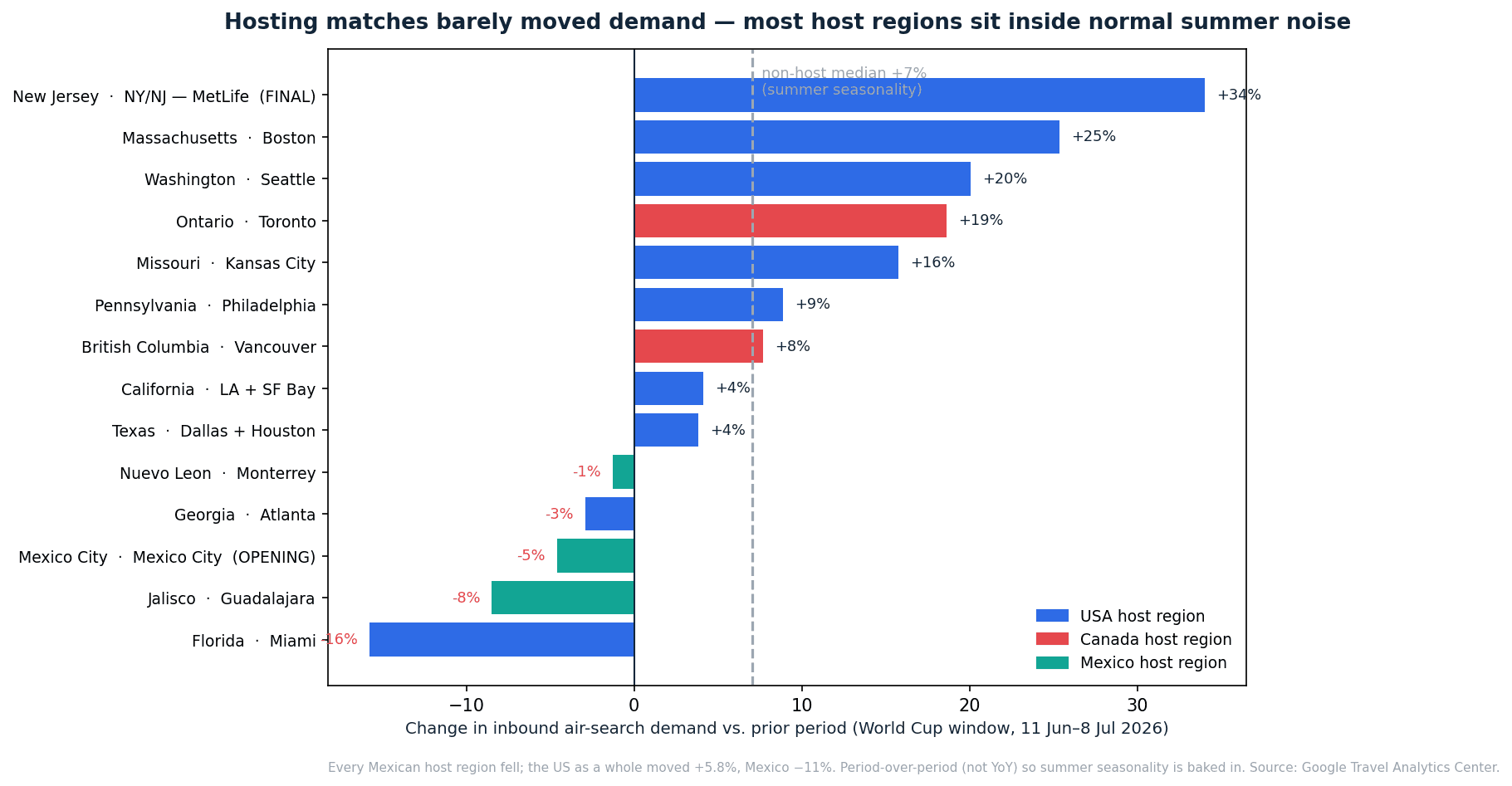
Caption: Host regions moved no differently than non-host regions. Every Mexican host city fell; the "winners" are just northern summer markets.
The only thing that actually moved: novelty
So which participating nations got a real bump? I split around 50 destination countries into World Cup participants and everyone else. The answer is blunt: participating produces no group-level uplift.
The trap is in the average. The mean year-over-year change for participant nations looks impressive at plus 32%, until you notice that one country, Cabo Verde (up 922%), is single-handedly dragging it up. Strip out that one outlier and participants average minus 10%, with a median of minus 13%. Non-participants? A median of minus 9%. The two groups are statistically identical. In fact 19 of 22 participant nations are down year over year: Spain down 14%, Germany down 16%, France down 17%, England down 19%, Brazil down 5%, Argentina down 7%, Portugal down 15%. Reaching, even winning matches at, a World Cup did nothing measurable for these established destinations. And here is the starkest proof of all, now that the tournament is over: Spain won the entire thing, and its inbound travel demand was still down 14% year over year. If lifting the trophy does not move a famous country's travel demand, nothing about mere participation ever will.
Never let a mean built on one Cinderella story convince you that "World Cup nations are up." They aren't. The uplift is a property of novelty and story, not participation. This is Vozinha's story told in demand data: the world didn't fall for Spain, because it already knew Spain. It fell for the tiny island side that had no business being there. That effect belongs to genuine debutants, and it scales with the run: unknown plus remarkable equals huge; familiar equals nothing. If you market an emerging, low-awareness destination whose team reaches a major tournament for the first time, expect a real lift, bigger the further they go. Everyone else gets airtime and no bookings.
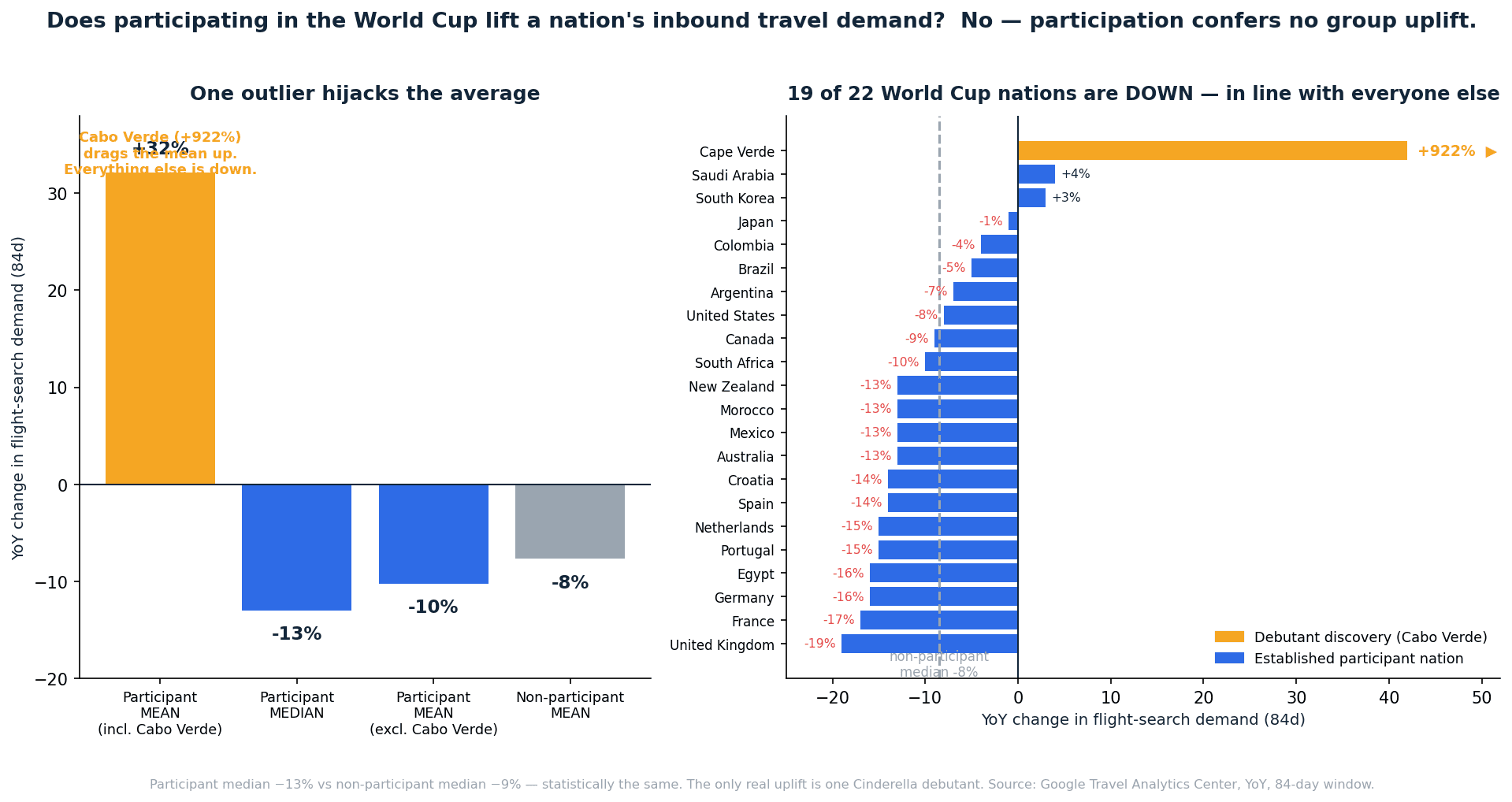
Caption: The participant "average" of +32% is one country. Strip out Cabo Verde and 19 of 22 World Cup nations are down, in line with everyone else.
Translating the shock into PPC decisions
Here is where demand theory meets the auction.
Don't chase the curiosity peak with conversion budget. Bidding hard on "flights to Cabo Verde" against the US surge means paying inflated event-season CPCs (travel CPCs already average around $2 and spike 30% to 100% under pressure) to reach people who mostly cannot or will not travel there. That's not marketing; it's a donation to Google.
Capture the curiosity, don't convert it. Harvest the awareness spike into audiences (remarketing lists, email, social) and judge it on audience-building, not last-click ROAS. The American who searched during the Argentina match is a long-lead brand prospect, not a this-season booking.
Concentrate conversion spend where awareness meets access, the intersection of new interest and can-actually-get-there: Germany, Spain, the Nordics, and re-energising the UK, where charter capacity exists. Expand into intent-rich long-tail terms there ("direct flights to Sal from [city]," "Boa Vista hotels October") rather than bidding up generic head terms globally.
Mind the lag. Searches peak on match days, but bookings land weeks and months later (operators reported strength in the autumn). Pace budget to the booking window, not the attention window. And respect the supply ceiling: Cabo Verde's air capacity is limited, so demand that outstrips seats just inflates fares.
The unglamorous hero: negative keywords
If there is one thing I'd tattoo on every travel account before a tournament, it's this: your negative keyword list is the difference between capitalising on a moment and setting money on fire during it.
When a country or city name goes viral for football, the volume around it explodes, but almost all of it is non-commercial. People search "Portugal vs Spain," "where is Cabo Verde," "Spain Cabo Verde score," "Cabo Verde goalkeeper," "Cabo Verde vs Argentina highlights." These are match, map and trivia queries, not travel intent. And because they contain the exact place names your campaigns are built around, loose structures happily serve ads against them. Broad match will cheerfully spend your budget showing "Flights to Cabo Verde" to a teenager looking for a goal replay. It's the same curiosity-not-intent problem, now live in your auction on inflated CPCs.
So before and during any tournament involving a destination you advertise: build a football and event negative list (vs, score, result, match, fixtures, live, highlights, lineup, goal, penalty, table, standings, squad, national team, world cup, goalkeeper, kit, jersey) and apply it at account level. Add the human-story names as they trend, like "Vozinha." Watch the search terms report daily, not monthly, because the junk mutates overnight. Tighten match types for the duration and lean away from broad. And if you do want to capture the newly curious, do it deliberately in a low-bid awareness campaign with its own budget, not by accident through your conversion campaigns.
Negative keywords never make the case study. But in a tournament they are the single highest-ROI hour of work in the account. The teams that win these moments aren't just the ones who show up for the demand. They're the ones who refuse to pay for the 90% of it that was never going to book.
A personal note before the next one
In four years the World Cup comes to Portugal, Spain and Morocco, and as a Portuguese who lives in California and flies home every summer, I could not be more excited to see my country host it. And yet I already know I will not be visiting Portugal as a tourist during that tournament, and this analysis is a big part of why.
Events like this bring people, which is wonderful for the country and its economy. But they also make the destination genuinely hard to enjoy for the travelers who came for the place itself. Prices explode, availability collapses, and the quiet summer I love turns into a scrum. That's the crowding-out effect, felt from the other side of the counter. A demand spike is not automatically good for everyone it touches: for a hotelier it can be a windfall, and for the loyal repeat visitor it can be the summer they decide to go somewhere else. Understanding both sides is what separates marketers who chase spikes from the ones who actually build destinations worth returning to.
You cannot manufacture a Cabo Verde. The exposure came from a genuine sporting miracle, not a campaign. What you can control is whether your content, tracking and paid media are ready to catch a demand shock and route each slice of it to the right place. Readiness beats reaction, and the winners aren't the ones with the biggest budgets. They're the ones who can tell curiosity from intent in real time.
Sources
Primary demand data throughout is my own access to aggregated Google flight-search demand data. Supporting facts and context:
Cabo Verde seal historic qualification: FIFA
Travelers are already seeking Cabo Verde out: Skift; search lift of 177%: FTN News; the "World Cup effect": Forbes
Vozinha, from electrician to Cape Verde hero: beIN Sports, ESPN
Portugal 0-1 Spain, Round of 16 (Ronaldo's last World Cup match): ESPN, FIFA
Crowding-out effect, 2010 FIFA World Cup: Development Southern Africa; mega-events and tourism, Brazil: Baumann & Matheson; hosting impact review: Harvard Growth Lab
Displacement, FIFA World Cup 26 Los Angeles: Micronomics report; softer host-city hotel numbers (New York): XIRA
Average travel and hospitality CPC, 2026: PPC Chief
A note on the data: "ad opportunity" is indexed, rounded generic-air-query volume, a demand proxy, not bookings. Different reports index on different scales, so this analysis compares shares and directional change, not raw counts across reports.



Featured contributor on the HubSpot
Sam Lauron Dec 14, 2023
When and How to Build International PPC Campaigns
“One-size-fits-all templates don’t work,” says Flavio Rodrigues, an SEM consultant who runs the consultancy, Digital Sardine. “There are differences in languages and dialects, currencies, user behaviors, and even payment methods,” he adds.