
Americans are flying to Europe at last year's pace. The Google searches advertisers can bid on fell by a sixth. Here's where the planning went, and what to change before 2027. · 6 min read
Oct 21, 2026 · @Flavio Rodrigues
Americans are traveling to Europe at about last year's pace, and to some countries much faster. Yet ad-eligible Google searches for those trips fell 15% for flights and 23% for hotels between August and mid-October. For anyone buying travel demand on Google, that gap is the story to plan 2027 around.
Two numbers that don't agree
Official counts say the trips are happening. Google's ad inventory says they aren't.
Measure | Period | Change vs last year |
|---|---|---|
US citizens departing to Europe (NTTO) | May 2026 | +2.2% |
US citizens departing to Europe (NTTO) | July 2026 | -1.2% |
US tourists arriving in Spain (INE) | August 2026 | +31.9% |
US tourists arriving in Spain (INE) | Jan to Aug 2026 | +11.6% |
Ad-eligible Google searches by Americans, flights to Europe | Aug to mid-Oct 2026 | -15% |
Ad-eligible Google searches by Americans, European hotels | Aug to mid-Oct 2026 | -23% |
The windows don't line up exactly. Official US outbound data runs two to three months behind, and Spain's August jump may partly reflect a soft month last year. But the direction isn't close: travel is flat to up, and the Google ad inventory for it is down by a sixth or more.
A note on what the Google numbers count: ad-eligible searches, meaning searches on Google where a travel ad can appear. That's the inventory advertisers actually buy. It can fall because fewer people search, or because more of the planning happens in places where those ads don't show. For an advertiser it comes to the same thing: the inventory you can buy shrank while the travel market didn't.
Where the searches went
The trips didn't disappear, so the planning moved. The likely destinations are Google Flights and Google's own hotel results, which sit outside classic search ads; AI Mode; ChatGPT and other assistants that now plan whole itineraries; and OTA apps travelers open directly.
AI is the fastest-growing piece. Among Americans who have used AI to research or book travel, 49% now rely on it most or all of the time (Bain). Yet traffic from AI platforms is still under 1% of visits in every travel category, even after quadrupling for hotels and rentals in a year. Travelers are planning in AI and booking somewhere else, often after a branded search or a visit straight to the OTA. The planning moved; the clicks haven't caught up.
The clearest clue is in what Americans stopped searching for.
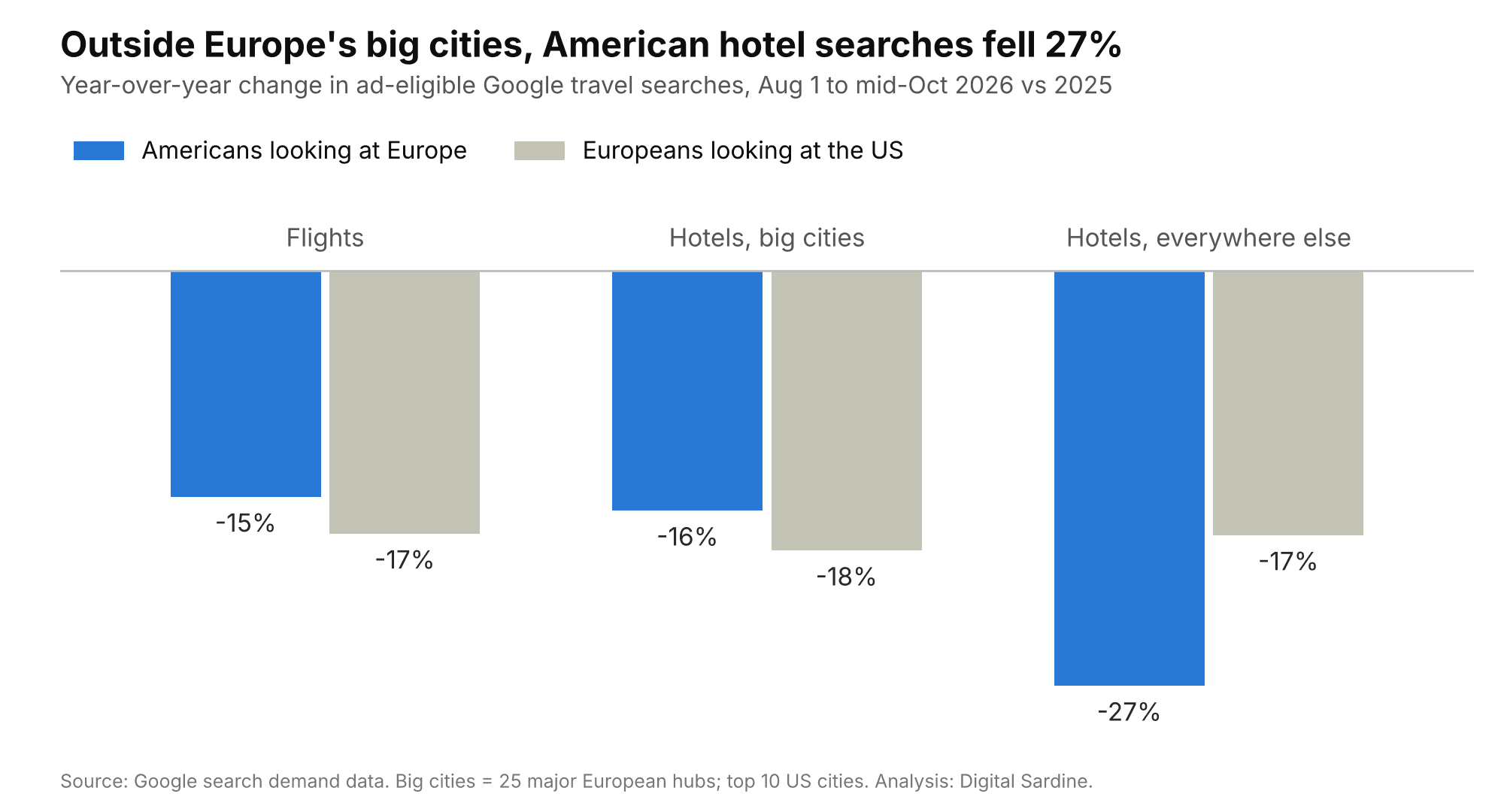
In Europe's major hub cities, American hotel searches fell 16%, in line with flights. Everywhere else they fell 27%: Positano down 36%, Split 36%, Nice 32%. Europeans planning US trips show no such split.
There are two ways to read that, and search data alone can't settle it. Travelers may be cutting the second stop. Or they're still booking it but discovering it somewhere other than a search box: an AI itinerary, an OTA's recommendations, a creator's video. The official numbers make the second reading more likely. Either way, the add-on destinations are where Google's ad inventory is losing the traveler fastest.
The exception: Europeans really are traveling less
Inbound is a different story, because here search and reality agree. Overseas arrivals to the US fell 6.5% in May and 7% in July (NTTO), and Western European arrivals fell 10% in May (AltexSoft). Ad-eligible Google searches by Europeans for US flights fell 17%, and for US hotels 18%.
The pullback is uneven. Searches for US flights from France, Germany, Austria, Switzerland and Benelux fell about 22%. The UK and Nordics fell 13%, and Central and Eastern Europe only 6%. The reasons most often cited are political, starting with how welcome visitors feel at the border.
It isn't the exchange rate, in either direction. A softer dollar should make the US cheaper for Europeans, yet fewer are coming. For Americans, the euro averaged about $1.16 to $1.17 last autumn (Pound Sterling Live) and traded around $1.15 to $1.16 this August and September before sliding to $1.12 in mid-October (Pound Sterling Live). Europe got slightly cheaper this year, not more expensive.

What this means for your paid media
This analysis covers the transatlantic market only; domestic travel and other routes may look different, so check your own markets before assuming the same gap. But where Google's ad inventory no longer tracks travel demand, a lot of planning habits break. Five changes to make before the 2027 planning wave hits in January:
Stop reading search volume as demand. Ad-eligible searches down 15% while trips hold steady means a smaller auction, not fewer people buying. Forecast from bookings and official travel data, and treat search volume as one input among several.
Judge your account on share, not volume. A smaller auction serving the same travelers makes each search worth more, and your competitors know it. Track impression share, conversion rate and cost per booking: a flat account in a shrinking auction is winning.
Follow the planning off the results page. Google Flights, hotel ads and metasearch absorbed much of this demand, and they're bought differently from search. If you sell trips, stays or tours and you're only in classic search ads, you're bidding on a shrinking slice.
Test ChatGPT Ads while the auction is still empty. I've been running ChatGPT Ads for travel brands since the beta. Across dozens of short-stay lodging queries, Expedia was the only advertiser showing up, and early non-brand results put CPAs in line with Google non-brand search. The full breakdown, from the $3 practical bid floor to who's advertising, is in my ChatGPT Ads guide for travel brands. That window won't stay open.
Sell the second stop from the first. Demand still lands on Google for Rome, Paris and London. If you sell the Amalfi Coast or a villa in Croatia, bid where the planning still happens: day trips from Rome, Rome to Amalfi, things to do near Paris.
For US brands selling to Europeans, the decline is real travel, so the answer is reallocation, not new channels. Shift budget toward the UK, the Nordics and Central Europe, where demand is holding, and away from France, DACH and Benelux.
About the data
Search figures come from Google search demand data for travel: ad-eligible flight and hotel searches on Google.com in two directions only, Americans searching for Europe and Europeans searching for the US, from August 1 to mid-October 2026, compared with the same dates in 2025. Searches made inside Google Flights aren't included. Official travel figures come from the US National Travel and Tourism Office and Spain's National Statistics Institute.
Hub cities are 25 major European destinations, including London, Paris, Rome, Madrid, Barcelona, Amsterdam, Dublin, Lisbon and Athens. For Europeans visiting the US, the comparison uses the top 10 US cities.
Changes for groups of countries or cities are weighted and should be read as directional.
Low-volume destinations aren't quoted, and a few locations with inconsistent geography were excluded.
Last year's US-to-Europe data includes a two-day spike in late September, which makes this year's decline look 2 to 3 points larger.
Sources






Featured contributor on the HubSpot

Sam Lauron Dec 14, 2023
When and How to Build International PPC Campaigns
“One-size-fits-all templates don’t work,” says Flavio Rodrigues, an SEM consultant who runs the consultancy, Digital Sardine. “There are differences in languages and dialects, currencies, user behaviors, and even payment methods,” he adds.